Tag Archives: coronavirus

The latest Party line: Criticism of Xi Jinping’s regime will worsen pandemic

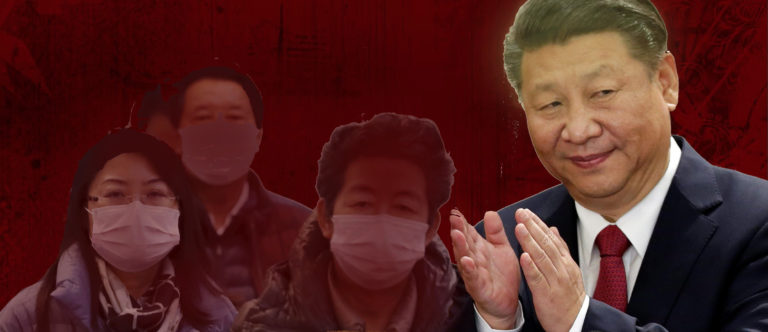
The latest line from the Beijing is that criticism of the Chinese Communist Party from anywhere in the world will only serve to extend the agony of the global pandemic.

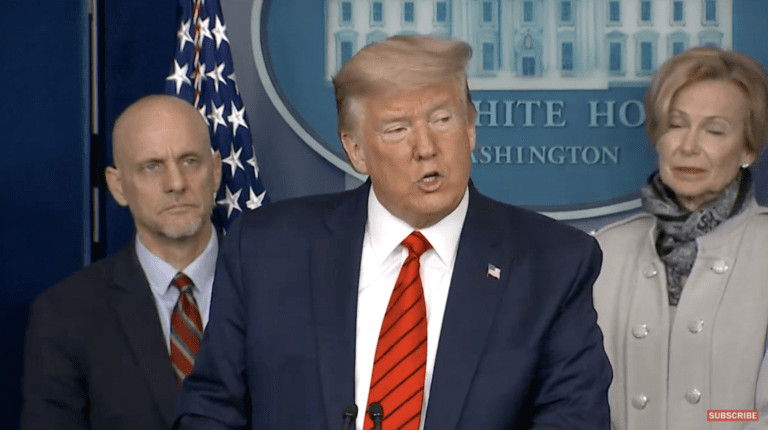
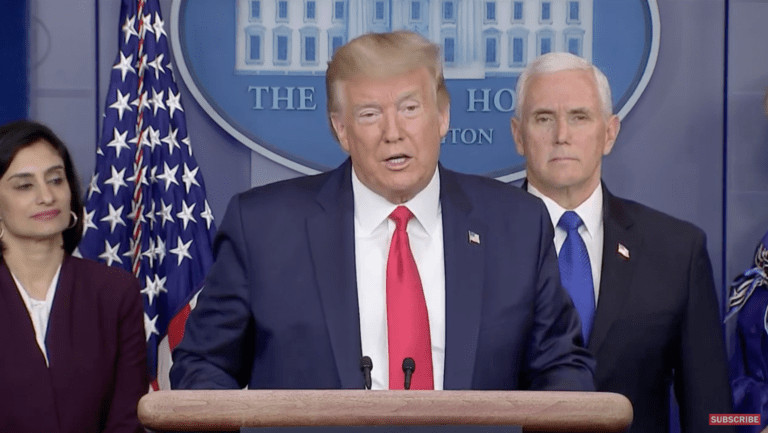
The new party line came on March 25 in the CCP’s authoritative People’s Daily a week after the Trump Administration started holding the CCP responsible for the worldwide spread of the deadly disease, and a day after Secretary of State Pompeo outlined the administration’s new approach.

The Center for Security Policy has been carefully monitoring CCP’s propaganda internally and to the world, and chronicling it with Chinese government actions, statements and policies from the Trump administration, and reports and commentaries in the western media.

The March 25 propaganda line shows an insecure Chinese regime that portrays itself as the protector of all the Chinese people, a responsible and generous citizen of the world that seeks the best for everyone, and as a falsely accused, innocent victim of the pandemic.

The party line is important to understand so that we in democratic societies can recognize it, understand what it means, identify how it is repeated in our open political cultures and who does the repeating, and counter it.

Main party line: All the world except Trump is thankful to China

Several CCP outlets have been publishing endless thanks from around to China and praise for its leadership. Many of the expressions are real, and many come from individuals who are not identified. The theme is to isolate anyone like President Trump and his government who criticize the CCP or seek to hold it accountable, and repeat the theme that China under the Communist Party can do no wrong.

The March 25 People’s Daily article, under the pen name Zhong Seng that is traditionally used to indicate a CCP statement on foreign policy, makes these points for party loyalists and fellow travelers to follow:

  • ‘Some’ in US are discriminatory & ‘pass the buck to China.’ “Some people in the US are obsessed with rude and unreasonable practices . . . . They intentionally fanned up the ‘political virus’ with discriminatory remarks in an attempt to pass the buck to China.” (Flashback: Being’s Central China TV station was one of the first to call the pestilence the “Wuhan Virus” as early as January 9, and official media kept using the term until the CCP changed its line in late February.)
  • ‘Wrongful’ criticism of China’s low transparency and for holding China responsible. “They wrongfully criticized China for a low level of transparency and openness regarding the COVID-19 information sharing, and evilly fabricated rumor that China should be responsible for the spread of COVID-19 in the US. Such conducts are condemnable.”
  • Evil to have ‘innocent’ China pay for the destruction. “What’s worse, these people even asked China to pay for the loss suffered by the US during the epidemic, which is nothing but engaging in evil doings and malicious discrimination of the innocent.”
  • US must repent. “The US side needs to reflect on what it has done to prevent and control the virus in the past two months.”
  • China impeded nothing and offered to help US. The article recounts a litany of US and Chinese statements and exchanges (most of which were only of protocol or other superficial purpose or value) in an attempt to show “that China has not impeded the US efforts on coronavirus control, but offered the US assistance in this regard.”
  • Critics of Chinese regime are ‘heartless.’ “Those US politicians stigmatizing China are totally heartless.”
  • US is to blame for its own delays. “The US should blame itself for difficulties it has encountered in fighting against COVID-19.”
  • CCP won the world valuable time. “It is globally recognized that China has won valuable time for the world to fight coronavirus with its achievements in epidemic prevention and control. . . . The US media outlets know how ineffective their government has been in front of the epidemic.”
    • Cites ex-Clinton/Obama official and Henry Kissinger chair: “Kurt Michael Campbell, formerly Assistant Secretary of State for East Asian and Pacific Affairs of the US, said bluntly that China’s extremely strict epidemic control measures have won the US a lot of time, but it’s not clear wither the US has made effective use of the time.”
    • Cites World Health Organization. “The World Health Organization (WHO) has repeatedly expressed that China, by adopting forceful measures against the virus, is protecting the lives of the Chinese people and people of the world.”
  • Communist China is a helpful and generous world citizen. “China, sharing a common destiny with the world, actively offered assistance to other countries after the epidemic broke out overseas. The country has dispatched experts and donated prevention materials to affected countries, and exchanged virus control experience and treatment plans with the world, deepening international cooperation on virus control.”
  • The whole world lauds, admires, and thanks Communist China. “To laud China’s actions, admire China’s responsibility, and thank China’s assistance has become the mainstream voice of the globe.”
  • US is a slacker and a back-stabber. The US “owes money to WHO, “planned to halve” its WHO funding in 2021, and “when the epidemic broke out in china, the US acted as an onlooker, pointing fingers at Chinese prevention and control measures and even giving a stab in the back.”
  • By ‘smearing’ China for his own political gains, Trump undermines the world. “Now, as the epidemic satiation has worsened in the U.S., certain people there started to blame everyone but the U.S. itself. To smear China out of selfish political gains undermines the global efforts to fight the epidemic. The world knows who is responsible and who are not. As the WHO has warned, slandering other countries and people carries a greater risk than the virus itself.”
  • The Party line. “Some people in the United States are advised to lay down their political prejudices at an early date, isolate themselves from ‘political virus,’ and join the global war against the epidemic. Otherwise they will not only hinder anti-virus efforts at home, but also impede the global endeavor.”

Pandemics can fast forward the rise and fall of great powers

Originally posted on National Interest

As COVID-19 continues to spread in the United States, analysts are rightly focused on the possible medical and economic ramifications, but this pandemic is already shaping the most important geopolitical development of the twenty-first century: America’s great power rivalry with China.

How well Washington and Beijing manage the ramifications of the Coronavirus in the weeks ahead may determine who leads the international system decades hence.

After all, as I explain in a new book, global pandemics have contributed to the rise and fall of great powers in the past.

In the fifth century BCE, Athens was the leading power of ancient Greece. It was a wealthy trading state, the center of Greek arts and culture, and a naval power that had successfully led the Delian League alliance in the defeat of the mighty Persian Empire.

In the Peloponnesian War with its rival Sparta, however, Athens was struck by the plague in 430 BC. Believed by modern scholars to have been an outbreak of typhoid from North Africa, the illness decimated Athens’ population, depleted its military personnel, and even took the life of its most effective leader, Pericles. Prior to the outbreak, Athens appeared on the verge of victory, but weakened by the affliction, it sued for a temporary peace in 421 BC. When the fighting resumed, Athens was eventually defeated and its democratic form of government overthrown by the victorious Spartans.

Glick and Wurmser discuss how Israel is confronting coronavirus during a political crisis

While the Israeli government took a very aggressive response to stem the flow of coronavirus in the country — perhaps the first to take tough steps in the West – Israel is facing a political crisis in forming a new government which the Speaker of the Knesset is defying an order from the Israeli Supreme Court to allow lawmakers to vote on a new Prime Minister.

On March 24, 2019, Center for Security Policy President Fred Fleitz moderated a virtual panel discussion with two outstanding experts: Senior Analyst David Wurmser, who also is director of the Center’s Project on Global Anti-Semitism and the U.S.-Israel Relationship and Center Senior Fellow Caroline Glick. Glick participated in this virtual panel from Israel.

Caroline Glick, an Israeli journalist who served in the Israeli military and ran for a seat in the Knesset, said Israel is all but in full lockdown mode right now, with businesses closed and internal travel severely reduced.  She noted that the government very early on banned flights from China, and again very early on then banned flights from other countries, while placing all remaining arriving travelers for hot areas in quarantine.

Glick noted that The Israeli government has taken a publicly dire tone, at one point even warning that Israel may in the end suffer one million cases with thousands dead. Israel currently has over 1,800 cases, with a little over 30 in critical condition.  Three Israelis have died thus far. The curve for both is still in sharp acceleration in Israel, so there is no sign yet of a leveling off.

Wurmser said in the long term, it is likely that Israel’s economy will emerge from this crisis in a strong situation.  The decisive actions by the current caretaker government in Israel under Prime Minister Netanyahu took early on could limit the magnitude of the outbreak and might end it faster relative to other countries. Moreover, Israel’s economy is agile and innovative, and is well positioned to benefit from the highly dynamic post-crisis global economy.

Glick and Wurmser discussed at length the complicated political situation in Israel and the continuing failure to form a government after three inconclusive elections.  According to Glick, :we are in the midst of multiple crises concerning our politics.

Head of center-left block Benny Gantz allied with very anti-Israel, anti-Zionist, pro-terrorist joint Arab List that openly supports Iran, Hezbollah, Hamas in trying to oust Prime Minister Netanyahu.  She said Gantz is making deals with and offering positions to the Arab List.  Glick said it was unprecedented in Israeli politics for a major political party to strike an alliance with irredentist elements hostile to the Israeli state.  Glick also discussed how the Center-Left bloc has moved to use legislation and the Israeli courts to bar Netanyahu from becoming Prime Minister again and to force a vote on the new prime minister to their advantage.

According to David Wurmser, With the removal by the Supreme Court of current caretaker Knesset speaker Yuli Edlestein now all but certain, the Knesset will likely in the coming days proceed to pass the legislation disqualifying Prime Minister Netanyahu from being able to form a government, thus removing any alternative to Gantz’ forming one.  Moreover, since Gantz will still be unlikely able to form a government, and thus a fourth round of elections is quite possible, it would remove Gantz’ chief political opponent from being able to run for office, paralyzing the Likud party.

Wurmser and Glick agreed that while Gantz’s coalition may continue to prevent Netanyahu from forming a new government and could force a fourth round of elections, polls suggest that the current caretaker government under Prime Minister Netanyahu is handling the current Corona crisis well and with great popular approval.  They also noted that Gantz has suffered politically during this struggle for power due to his inability to form a government and his alliance with the Arab List.  Wurmser noted, moreover, that the trend line for Gantz and his party is downward and that Likud and Netanyahu gained seats in the last election round.

Gick outlined a more pessimistic scenario, but one which may be more realistic. Gantz will indeed be unable to form a government but may succeed in passing legislation to bar Netanyahu from being the Likud party’s candidate in the next election.  This would be a devastating blow to the 50% of the country who would see this a fundamental assault on the democratic choice.

Glick and Wurmser agreed that severe damage has already been done by the supreme court. By so heavy-handedly interfering without even answering the arguments put forward by the Knesset’s chief legal advisor, the court has involved itself in political rather than legal question and overstepped the lines between the judicial and legislative branches of government. The long-term damage to the integrity of the court will make judicial activism and the politicization of the courts an even greater hot-button issue in Israel. This probably ensures that it will take considerable time and effort to reverse the erosion of and reestablish the independence and credibility of the Israeli courts.

Amidst the COVID-19 outbreak, Iran and China choose regime health at the expense of world health

Despite the spread of the dangerous coronavirus, Tehran and Beijing have chosen to manipulate the outbreak to strengthen their strategic partnership and prop up their regimes. 

The coronavirus outbreak has revealed the extent of the Tehran-Beijing relationship. The two countries’ political, commercial and technological ties most likely facilitated the rapid spread of the virus.

When the coronavirus hit Iran in early February, regime leadership chose to sustain the status quo of its economy. By choosing to prioritize the interests of the regime, officials jeopardized the containment of the disease.

Iran remains the most impacted Middle Eastern country by this pandemic. As of this week, Tehran claims its current death toll is 853 and counting, while the number of infections have breeched 15,000. It is extremely likely these numbers have been underreported, however.

Iran’s deputy health minister, Iraj Haririchi, became the first regime official to die from the virus last month. Footage of Haririchi downplaying the outbreak while displaying obvious symptoms became viral overnight. It has also been reported that the country’s vice president for women and family affairs, a top official in emergency medical services, along with dozens of parliamentary members have also been infected or have ultimately died from this virus. More recently, former member of the Expediency Council and chief of staff to Ayatollah Khamenei, Seyyed Mohammad Mir Mohammad, was declared dead in early March.

The severity and early on-set of the infection rate among Iranian elites is indicative of the deep Beijing-Tehran relationship. However, the strategic partnership between these two totalitarian states is not new. Beijing has a history of providing infrastructural, technological and commercial support to the world’s leading state sponsor of terror.

During the Iran-Iraq war years, Beijing provided Iran with ballistic missiles as well as fighter jet and anti-ship missile technologies. On the economic front, Beijing has become Iran’s most significant trading partner and oil customer, making up for 50-70% of its oil exports. In addition to oil, China remains the top investor in the Iranian market. China’s leading telecommunications company, Huawei, has been accused of providing Iran with American equipment and intellectual property theft, and violating US sanctions. Just last year, Iran’s Foreign Minister Mohammad Javad Zarif promised an unprecedented $400 billion in investment in Iran’s economy. This promise was clearly motivated by China’s global ambition to sustain a foothold in the Middle East, as part of their larger One Belt One Road (BRI) global initiative.

The pervasive ties between these two states extends to their overlapping anti-American propaganda efforts. China and Iran have recently been flooding international media outlets with messages accusing the US of manufacturing the coronavirus pandemic as a bioweapon. This week Beijing launched a campaign urging the U.S. to lift sanctions on Iran to aid in the regime’s coronavirus relief efforts. China’s ministry of foreign affairs tweeted, “Continued sanctions on Iran was against humanitarianism and hampers Iran’s epidemic response & delivery of humanitarian aid by the UN and other organizations.” Given Tehran’s track record, it is likely that any economic assistance will be funneled to its military and nuclear program.

While the international arena grapples with the coronavirus outbreak, Tehran and Beijing will use the crisis to further their long-term agendas and prop up their dangerous regimes.

Is Russia as unaffected by Wuhan virus as the Kremlin claims?

As the number of Wuhan virus cases skyrockets around the world, Russia reports only 367 cases, a surprisingly small number given Russia’s strong travel and trade relationship with China.

Reason for skepticism

 Russia closed its 2,600 mile border with China and stopped issuing visas to Chinese nationals on January 30th, which may have helped contain the spread of the virus.

“Testing and identification of cases, tracing contacts, isolation, these are all measures that WHO proposes and recommends, and they were in place all the time,” Dr. Melita Vujnoic, the world Health Organization’s representative in Russia told CNN. “And the social distancing is the second component that really also started relatively early.”

The World Health Organization (WHO) played down the severity of coronavirus and has since adopted Beijing’s talking points, severely damaging its credibility.

Though the Russian health ministry reports conducting 163,529 tests for coronavirus,

the Russian test is 10-16 times less sensitive than tests in the US, according to the Russian medical news cite, PCR News. It is likely many individuals positive for coronavirus wrongly tested negative.  Russian doctors have also raised concerns that the government is deliberately minimizing the number of reported cases.

Anatasia Vasilyeva, head of Russia’s Alliance of Doctors trade union, claimed the Russian government was covering up coronavirus cases as pneumonia. Moscow had 6,921 cases of pneumonia in January, an increase of 37 percent from last year. The Moscow Department of Health denied Vasileyva’s claims.

An anonymous Russian doctor told the CBC that he did not report several cases he suspected were coronavirus because he did not want to be quarantined and have his offices shut down by authorities.

Limiting press

It is unsurprising Russian citizens are skeptical of the government’s reported numbers, given its reputation for misleading the public. Last August, Moscow repeatedly lied about a nuclear-reactor explosion at a military test site, playing down the severity of an accident that killed seven people.

Moscow has followed Beijing’s lead in controlling the coronavirus narrative. China allowed the coronavirus to spread worldwide by silencing whistleblowers and detaining doctors such as Li Wenliang who tried to warn about the outbreak. Beijing shut down media sources that did not parrot Chinese Communist Party talking points.

Russian authorities forced news outlets to take down “fake” news about coronavirus, threatening to revoke licenses of outlets that “sow panic.” The Govorit Magadan news website was ordered to take down a story about the death of a resident suspected of having coronavirus. Local police and regional FSB officers opened an administrative case against a woman for posting on social media that there were coronavirus cases in the Amur region, claiming it was bad information.

On March 4th, Putin claimed false information was part of an organized campaign from ‘abroad’ designed to create panic.

The outbreak has also given the Kremlin a reason to implement their advanced surveillance state technology/capabilities? On March 17th, Putin toured the “Safe City” surveillance center, which uses artificial intelligence and facial recognition software. Moscow Mayor Sergei Sobyanin told Putin they were able to track 95 percent of people with coronavirus using the technology.

Putin’s power grab

In a surprise visit to the Duma on March 10th to endorse a Constitutional amendment allowing him to run for two additional terms as President, Putin argued the stability he provides is necessary to overcome economic downturn, low oil prices and coronavirus. Protests against the changes were canceled in Moscow and St. Petersburg this weekend due to restrictions on public gatherings aimed at stopping the spread of the virus.

The social distancing restrictions have not, however, altered plans for the nationwide vote on the amendment on April 22nd.

Whether the Wuhan virus continues to spread in Russia or not, Vladimir Putin will continue to exploit the crisis to consolidate power.