Tag Archives: Howard Buck McKeon

Allen West: Keeping “the flame” burning

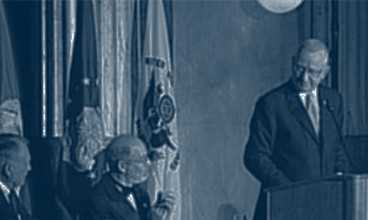
Rep. Allen West (R-FL) salutes Rep. Buck McKeon, the Chairman of the House Armed Services Committee, at the Center for Security Policy’s 2011 Keeper of the Flame. Rep. West spoke about the “flame” that is America’s national spirit in a moving benediction to close the evening. Below is video and a transcript of the Congressman’s remarks.


Remarks of CONGRESSMAN ALLEN WEST
The Center for Security Policy’s Keeper of the Flame Award Dinner
October 4, 2011, Union Station, Washington, DC

Senator Kyl and to my boss, Chairman McKeon, congratulations. To the commandant of the United States Marine Corps, General and Mrs. Amos, to all the soldiers, the sailors, the airmen, Marines, and Coast Guardsmen, to each and every one of you that’s sitting out there. It’s very tough for me to try to follow that up, but let me see if I can do the best that I can.

When I was sitting there tonight, Mrs. Amos asked me one simple question. She said, what possessed you to want to run for Congress? Well, probably it was too many jumps out of airplanes and hit my head. But I thought about something. Why we’re here tonight.

We’re here tonight because of a flame. And when we talk about a benediction, it takes me back to thinking about the first time a flame was introduced into this world. It’s very simple, when you go to Acts, when those men who were scared because the Lord and Savior Jesus Christ has been taken away from them, they were told to go to an upper room. And when they were there in that upper room, a comforter came. A comforter came to them in the sense of a flame. That gave them boldness that gave them an incredible spirit to go out and talk about something that had never been heard of, never been preached of before, all across the known world.

But see, that exact same flame somehow made it to these shores. That flame first appeared at a place called Lexington and Concord where men answered the call and went out and stood for something that the world had yet to understand.

That flame made another appearance in the embodiment of a man by the name of Thomas Jefferson when he wrote an incredible document called The Declaration of Independence, which set forth this great nation. That flame made an appearance at Valley Forge in a cold, dark night when our General George Washington knelt down on his knees and prayed and that flame led the way across the Delaware River to a triumph at Trenton. That flame, even though the British came here and burned down this great capitol, even though the British shelled Fort McHenry, that flame still remained.

It was a flame that President Abraham Lincoln talked about not too far away from here in a place called Gettysburg where he paid tribute to those who gave that last full measure of devotion for a country that was the last and greatest hope for this world, so that this government of the people, by the people, and for the people should not perish from this earth.

It was a flame it was a flame that led the way for pioneers as we expanded this great nation out west. It was a flame that somehow found its way into the Belleau Wood and to the trenches of World War One. It was a flame that rose out from the depths of Pearl Harbor, that somehow came out of the deserts of defeat at Kasserine Pass.

It was a flame that crossed the Pacific, landing upon beach upon beach, climbing Iwo Jima, it was a flame that landed at Normandy, it was a flame that shone brightly December 1944 at Bastogne. It was a flame that survived the Pusan Perimeter and landed at Inchon and even during those cold dreaded days and nights at Chosan, it still continued to burn. It was a flame that led the way through the dark triple canopy of Vietnam and it was a flame that continued to shine as these United States stood against the Soviet Union, what we knew was a Cold War, it kept us warm.

It was a flame that spearheaded one of the greatest open desert battles in Desert Shield and Desert Storm and led the way as those rockets and missiles from Apaches and MLRS and our strike forces went across and defeated what was supposed to be the mother of all battles.

It was a flame that in 2003, with men such as Colonel James Hickey, who was the second brigade commander, fourth infantry division, the brigade that captured Saddam Hussein, one of my dear friends and one of my former bosses who is here tonight.

It’s that flame that continues to shine ten thousand feet altitude in Afghanistan and it led the way for those US Navy SEALS to go and take down the world’s greatest known terrorist, Osama bin Laden.

Tonight, what is that flame? It’s the flame that each and every one of us has within us. It is the flame of freedom, it is the flame of liberty, and it is the flame of democracy.

And tonight, we have recognized and we have honored a man that at this important time in the history of this two hundred and thirty-five year, the longest running Constitutional republic that the world has ever known, you have been entrusted to be a keeper of that flame at this time. And I could tell you it’s such a great honor to be on your team on the Armed Services Committee.

Once upon a time I coined a little phrase that said, “I would go through hell with a gasoline can” and, sir, I would go through hell with gasoline cans to help you to be the keeper of that flame. Because for me, it was a flame that my father passed on to me, through a brother who served in Vietnam, from his service in World War Two, to my twenty-two years and now we pass that flame on to my nephew, who has already done two tours of duty in Afghanistan. The flame that is the United States of America, ladies and gentlemen, and shall never be extinguished.

It shall shine brighter, because the greatest days of this republic is ahead. I don’t care what stands before us. Our forefathers who first brought that flame to light at Lexington and Concord are looking down upon us right now. And we shall not let them down.

So as my benediction-I guess Frank since I’m from the south, I know how to preach-I would ask that God bless us, each and every one of us, that God keeps each and every one of us in the hollow of his hand. That God will continue to keep that flame that he first sent down some two thousand years ago to those men in the upper room in Jerusalem, the flame that we carry forth today.

Never forget that flame.

Never forget the men and women who have sacrificed so that we can carry forward.

And for Chairman Buck McKeon of the Armed Services Committee, you have been charged with a great mantle of responsibility, to be one of those few blessed Americans– such as Ronald Reagan, who believed in peace through strength– that you are now keeper of the flame of these blessed United States of America.

May God bless you all and thank you.


More from the 2011 Keeper of the Flame


Jon Kyl: Saluting Buck McKeon’s “unwavering commitment to strong national defense”

Three-term Senator from Arizona Jon Kyl joined the Center for Security Policy in honoring Congressman Buck McKeon with the 2011 Keeper of the Flame award. Sen. Kyl himself is a 1994 recipient of the award and a longtime supporter of the Center’s work. Below is video and a transcript of the senator’s remarks.


Remarks of SENATOR JON KYL
The Center for Security Policy’s Keeper of the Flame Award Dinner
October 4, 2011, Union Station, Washington, DC

Thank you very much. You know, one time I had the honor of introducing Dr. Henry Kissinger at a very small event in New York City. There were three tables about this size in a small room. Everybody there knew Dr. Kissinger at least as well as I did. But I was asked to introduce him. And, Frank, I did the same thing. I said, “this man needs no introduction.” Well, he came to the dais and said, “it may be true that I need no introduction, but no one enjoys one more than I do.” So thank you for embellishing that just a little bit. Carol and I are delighted to be here for, I don’t know, twenty-some events. And every one is-it’s just a real pleasure for all of us and especially so tonight. Particularly because I am pleased to introduce my friend and colleague representative, “Buck” McKeon, our honoree this evening.

Buck was named the ranking member of the House Armed Services Committee back in 2009 and then when the Republicans took over the House of Representatives, he was elected by his peers to chair the committee. As a member of that committee during my tenure in the House of Representatives, I can tell you that selection to this prestigious committee is a testament to leadership experience, the confidence of his colleagues, and an unwavering commitment to strong national defense.

These days, Buck’s job is one of the most difficult in Washington. He’s had to work to strengthen our military at the same time that appropriations are being slashed. He has succeeded, working with members of both parties, to deliver a defense authorization bill that supports our national security, even in the face of these imposed cuts. The committee was ordered to cut its budget to nine billion dollars below the president’s requests for 2012. What’s more, the budget control act requires an additional almost five hundred billion dollars in reductions over the next ten years. And on top of all of this is the threat of future defense cuts that would be triggered by the budget control act’s sequester mechanism in the event that the joint committee, which Frank mentioned I happen to serve on, doesn’t come up with a spending reduction package that Congress can pass. As Buck put it, any additional cuts, either from the joint committee or the sequestration trigger, would turn a debt crisis into a national security crisis. And he’s right. As a member of that select committee–and some of you may have read that I suggested that if they decided that they wanted to talk about defense costs that they would have to have somebody else serve on the committee, that I wasn’t there to serve on the committee to cut defense further. Buck and I talk on the phone a lot about how to prevent this from happening. We’re going to work very, very hard to see that it doesn’t happen.

Former [Defense] Secretary Bob Gates has said that further reductions would have a catastrophic effect on our national security. And [current Defense] Secretary Panetta has referred to sequester as a doomsday scenario. But not everyone fully grasps how harmful these potential cuts could be. Fortunately, Buck understands the need to educate others. So he’s directed his committee to hold a series of hearings that will address the implications of the first round of cuts and show what a sequestration doomsday scenario might look like.

Buck, I applaud you for your strong leadership on that issue. And I also want to especially acknowledge, with deep appreciation, your strong support for our nation’s nuclear deterrent and missile defense capabilities. Just an example: our ground based, mid course defense system, or GMD, is the only defense system capable of defending us against a long range missile attack from a country, say Iran or North Korea. The administration tried to curtail the modernization of this system. But Buck insured that the fiscal year 2012 budget requests for GMD were increased by a hundred million dollars. And this is at a time when, as you know, other cuts had to occur.

Likewise, Buck supports the modernization of our nuclear forces. He understands that as defense cuts lead to a decline in our conventional strength, the importance of our nuclear deterrent will only increase in future years. Our nation is well served with Buck McKeon at the helm of this powerful committee.

It’s a dangerous and complex world in which we live. We have to be able to respond to all of the threats facing our country, small and large, conventional and unconventional. We’re asking a lot of our military men and women these days and they simply can’t do it without proper support from the United States Congress. And that’s why Buck is here. To insure that our country fulfills its first and most important promise to its citizens, that it will keep us safe.

It is a great pleasure for me to introduce to you tonight, the Chairman of the House Armed Services Committee, the gentleman from California, Buck McKeon.


More from the 2011 Keeper of the Flame

2011 Keeper of the Flame Award: Howard “Buck” McKeon

On Tuesday, October 4th 2011, the Center for Security Policy presented U.S. Representative HOWARD P. “BUCK” McKEON with the Keeper of the Flame Award.

Rep. McKeon embodies the Center for Security Policy’s ideals. He champions a strong national defense, he fights to strengthen our military and he invests in a force postured to meet the challenges of the 21st century. Representative McKeon was selected by his peers to serve as Chairman of the House Armed Services Committee in the 112th Congress. Previously, as Armed Services Committee Ranking Member, Representative McKeon worked to provide the necessary resources for America’s sons and daughters in Afghanistan and Iraq. He also led efforts to keep terrorist detainees off of U.S. soil, boost funding for missile defense, and restore the tradition of passing defense authorization bills devoid of controversial social items.

Below is video of Rep. McKeon’s remarks, followed by a transcript.

HOWARD McKEON: Thank you, Senator Kyl, for that very, very warm introduction. Many of those things he gave me credit for, he’s the leader that makes it happen. There is no stronger proponent in this town for our national defense, for our missile defense, than Senator Kyl. And I am so thankful that he is on that special committee. I can’t think of a better person to be there at this time. You know, a few of us on our committee had a meeting yesterday with Secretary Rumsfeld. And we were talking and we got talking about you. And he said, what a great loss that is going to be to the Senate and to the nation when Senator Kyl retires. Thank you for your service.

Thank you to Frank Gaffney and the Center for Security Policy. You know, we’re fighting a tough fight, but I feel like everyone in this room is a strong ally. And I thank you for all you’re doing.

General Amos, Lonnie, thank you for being here. Thank you for being the commandant at this time. We really need you. We had a little meeting earlier today and I wanted to impress him, so I wore my Marine cufflinks that he gave me. The closest I get to a Marine, you know, that’s a good thing to do. I’m honored to be sitting next to Allen West. He says, how come they put us at the left? I said, no, we’re at their right. Most importantly, thank you to all of you veterans here tonight and especially you wounded warriors. We appreciate very much your service to this great country.

You know, there’s an old story about an Air Force test pilot who was testing out one of our first fighter jets. In that flight, he experienced some malfunction and had to crash land near Edwards Air Force Base out in my district in California. When the rescue crews arrived, they saw this bloody pilot, experimental aircraft with the wings and the tail gone and the fuselage torn into pieces. The sergeant who was leading the crews rubbed up-rushed up and said, sir, what happened? The Air Force pilot replied, I don’t know. I just got here myself. You know, that courage in the face of immense danger is one of the things I admire so much about our armed forces. We should be extraordinarily proud of these guys and gals. The brutal Hussein regime is a faded memory and al-Qaeda is on its back. It’s a defensive outfit now. They’re committed to their own survival, which significantly limits their ability to bring violence to our shores.

Since the attacks ten years ago, the group is a shadow of its former self and its former strength. Almost all of their senior leadership has been killed or captured. Their core operational strength has been decimated. After a daring raid earlier this year, their leader, Osama bin Laden, was killed and unceremoniously dumped in the ocean. And last week, a key al-Qaeda recruiter, plotter, and propagandist, Anwar al-Alawki was killed.

Friends, no matter which way you cut it, we’re winning this war. But like all conflicts we’ve made sacrifices to secure peace on the homefront. In the aftermath of the attacks, we all understood that rooting out al-Qaeda’s global network would take time and patience. We knew the war would be long, we knew that volunteers, not conscripts, would shoulder the weight of this fight. But we forgot that bringing an all-volunteer force into a protracted war hasn’t happened since the American Revolution. We forgot that long wars sap the will and the spirit of free societies. I think anyone who studied our experience in Vietnam would have counted America out by now. But here we are, ten years later, still fighting with our heads held high and our ranks swollen with new recruits. Sadam Hussein and Osama bin Laden, our two chief antagonists after the fall of the Soviet Union, have taken to an early grave while our republic is as tall and strong as ever. It’s al-Qaeda, not the United States, with its back on the mat.

Recently, I visited Fort Jackson, South Carolina, to watch my granddaughter graduate from Army basic training. I had the privilege of looking out over five hundred new soldiers marching straight and looking sharp. As were their family members, who filled the stands. It was hard then as it is hard now not to be struck by the magnitude of this event.

This country has been at war for ten long years, ten tough years. Yet amid all the pessimism and the naysaying, here were these five hundred volunteers, standing tall and beaming with pride. For the past ten years, there has been no shortage of sideline naysayers telling us what the United States can’t do. Through their actions, these young men and women show the folly of trying to impose limitations on this great nation. They signed up to answer the call, knowing that this is a war that doesn’t respect traditional boundaries or dimensions of conflict. They signed up knowing that it didn’t matter if they were a cook, a mechanic, a rifleman, or a quartermaster. They’d all taste the trials of combat. They signed up knowing their lives would be put on the line. Occasionally, in our republic’s history, a generation rises out of the ashes of tragedy and dismay to light our path upward.

This nation was born after an organized group of militia men banded together and freed our land from tyranny. It was preserved when one of our great leaders and statesman swore that this union would never perish from the earth, uniting our country and forcibly freeing a captive people from slavery. And it realized its destination-it’s destiny, when the greatest generation rose up from the pain of the Depression, looked an unstoppable Nazi war machine in the eye and said, no more. And no further. It seems like whenever we have our back against the wall, whenever we are cornered, and whenever we look to be down for the count, a special class of citizens frees us from uncertainty and doubt. It happened during the Revolution. It happened during the Civil War and World War Two. And it is happening today, folks. The 9-11 Generation and this-is this nation’s great hope. They are our way forward.

When I see someone in uniform, I see salvation from this war and even our economic woes. You’ve honored me tonight with the Keeper of the Flame Award. I thank you for that. But let’s never forgot that as a Congress, we are just caretakers of the torch. This generation is the flame, the light which will keep this country burning bright in the darkness of an uncertain world. They are the ones who deserve our praise and admiration, because this generation has character, they have determination, and purpose. And when they hang up their uniform, they will go into law and business and government. And they will take their selflessness and their service, their commitment and their integrity and they will spread it to every corner of our society. Because just as the 9-11 Generation understands service, they also understand sacrifice.

And friends, if you understand sacrifice, you don’t take this country for granted. You don’t itch away at its moral and patriotic foundation under the false banner of progress. Citizenship is sweeter when it is earned. And this generation has earned its citizenship a thousand times over. Many of you remember the Vietnam era when some who were angry about the war, to their eternal shame, directed their anger at our troops. This was disgraceful. But one of the wonderful things about this country is that we’re pretty good at righting our ship when we’re wrong.

You’ve honored me with this award, but if you really want to honor me, honor the sacrifices made by this new caste of citizen soldiers. Which you do everyday. And I thank you for it. We all know the names of famous Hollywood actors and actresses. Brad Pitt. Angelina Jolie. And everyone knows their name and their accomplishments. But Jared Monti, Michael Murphy, Paul Smith, Jason Dunham, Michael Monsoor, Ross McGinnis, Robert James Miller, Sal Giunte, LeRoy Petry, and Dakota Meyer are not household names. Each of them was awarded the Medal of Honor for heroism above anything that could be captured in a Hollywood script. Shouldn’t we at least pay them the same adulation as sports heroes or movie stars?

Now most of you are aware that there’s some pretty steep cuts to the defense budget on the table right now. Without going into too much detail, this is a battle that we must win. I thank both Frank and Senator Kyl for their efforts on this critical front. The sword hanging over the Congressional Super Committee represents one of the greatest threats to our standing in the world and our security that we have faced since the Carter years. We’ve proven that the enemy cannot break us on the field of battle. But in the coming months, Washington may do what no army in history has been able to accomplish, break the American military.

The trigger built into the super committee is so draconian, an Air Force officer recently said that if the trigger was pulled, the service would, and I quote, have to change the way we do business or change the business we do. We must keep that in mind as we slog our way through this war. Because those we sing the praises-though we sing the praises of the 9-11 Generation, we’re also in danger of cutting their legs out from under them.

A couple of weeks ago, I sat down with a group of Marines and their families at Camp Lejeune. Sometimes we forget that the families bear the same hardships as their deployed loved ones. Many of the wives I spoke with had reared children and families alone while their husbands were off on their fifth and sixth deployment. They were blunt with their concerns. How can we consider cutting their benefits after they have sacrificed so much? How could we vote to shrink the gov-the equipment, the leadership, and training that keeps their spouses alive? There are no easy answers to these questions. Because, frankly, they had a great point. And it begs a question that I ask my colleagues everyday. If we try to break the back of this recession on the back of our military, then who will have our backs the next time we’re attacked? You don’t make drastic cuts to the military during wartime. Not when we’ve got troops outside the wire everyday fighting their enemies for us and putting their lives on the line to keep us safe.

During the same trip, I had the honor of visiting recovering wounded warriors. The care we give them has been simply amazing. I met one young corporal who suffered from PTSD. He has anxiety attacks, wakes up in the middle of the night. So doctors gave him a specially trained dog that can sense when an attack was coming on. Even in his sleep, the dog will wake him up and comfort him. That type of innovation is really astounding. It reminds us that the wounds of war aren’t always physical or even visible. But I’m concerned about what happens to programs like that when we consider cuts of up to a trillion dollars from the defense budget.

We have to put this debt crisis in a perspective if we’re to find our way back into fiscal responsibility. There are some in government who think we can choose between military spending and entitlement spending. As if our troops could pay our ballooning social welfare tab.

First, let’s point out that this is a mathematically impossible feat. You could cut the entire defense budget and still be running a deficit. You simply cannot balance the budget on the backs of our soldiers. Second, I think we have mixed priorities. When we go to the Pentagon for savings first and not mandatory spending programs like social security, Medicare, Medicaid. Secretary Rumsfeld brought up a great point yesterday. Not all government programs are created equal. We have a constitutional obligation to provide for the common defense of this nation. It is our first and most sacred obligation. Our troops have sacrificed life and limb for the people of this great country. So why do people insist that their benefits, their entitlement, the support that they have earned, should be reformed before the entitlement programs that are bankrupting us? It just does not make sense.

Consider that word, entitlements. Well, entitlements imply that you are allowed a certain perk or benefit. I can’t think of anyone who has earned that right ahead of our troops, who have spent the last ten years fighting for us. Don’t get me wrong. In a seven hundred billion dollar defense budget, there’s bound to be some waste and inefficiency. The taxpayer dollar is sacred. But with that in mind, the well-being of our fighting forces must be our top priority. We must confront the waste in the Pentagon as aggressively as we fight the enemy. Every time I visit places like Camp Lejeune or Fort Jackson, I’m reminded that this is the immense duty I have as chairman. I take it as my personal responsibility to insure the troops and their families have the best training, equipment, and leadership in the world. That they have everything they need to carry out their assignments and return home safely. That’s my pledge to them and to all of you this evening. I will always fight for those who fight for us. I will never let up just as they never let up. I will fight to protect them just as they fight to protect us. I will always be on their side just as they never leave our side.

Today that fight is to convince those who are focused on math, no strategy, that there are larger issues at stake. That they can do real harm with deep, blind cuts. And those who ask me, well, what about just cutting another hundred, two hundred, or three hundred billion more? Or can’t we do more with less? I remind them that our military has been cut more than any other part of the budget. I remind them that we are already asking our troops to do more with less. And then I paraphrase a great American president. The buck stops here. The 9-11 Generation is a bright, burning flame in a dark decade. Let’s fight to keep their torch held high and honor their sacrifice, their service, with our own. Thank you for this award. Thank you for coming this evening. And thank you to all who’ve worn the uniform and defended this great republic. Thank you very much.