Tag Archives: Iran

Is Iran winning or losing?

Originally posted on the Israel Haymon

There’s an old Jewish joke where a young man walks up to his grandfather and asks him how he’s doing.

The grandfather answers, “In a word, good.”

“And in two words?” the grandson presses.

“Not good,” his grandfather replies.

The events of the week call the joke to mind in relation to Iran and its war against Israel and the United States.

On Sunday, a crowd of thousands gathered outside the US embassy building in Tehran and chanted, “Death to America, Death to Israel.” The Iranians sounded their customary death chants to mark the 40th anniversary of the seizure of the US Embassy and the hostage crisis it precipitated.

Sunday’s demonstration was the opening shot in a week of hostile actions by Iran. On Monday and Tuesday, senior Iranian officials announced they are abandoning key limitations set on their nuclear activities as per the deal they concluded with the Obama administration, the EU, Russia and France in 2015. On Monday, Iran announced it expanded its uranium enrichment at the Natanz nuclear installation with advanced IR-6 centrifuges, and that it is doubling the number of IR-6 centrifuges presently being used.

Tuesday Iranian President Hassan Rouhani announced that Iran is renewing enrichment activities at its Fordo nuclear installation, built inside of a mountain outside Qom. According to Rouhani, beginning Wednesday, Iran would begin enriching uranium at Fordo to 5% by injecting its centrifuges with uranium gas.

Many commentators responded to Iran’s announcements by declaring that the Trump administration’s “maximum pressure” strategy for scaling back Iranian aggression and thwarting its nuclear program has failed.

President Donald Trump’s campaign, which is enthusiastically supported by Israel and the Sunni Arab states, is comprised of continuously escalating US economic sanctions against Iran. Those sanctions are reinforced by US-supported military operations by US allies – primarily Israel and Saudi Arabia – against Iranian forces and Iranian proxies in Syria, Lebanon, Iraq, and Yemen.

There are three legs to the claim that the maximum pressure campaign has failed. First, its critics note, the US sanctions have failed to destroy Iran’s economy. This week Foreign Affairs proclaimed that Iran has survived its sanction-induced recession. Its economy, now at zero growth, is no longer shrinking. Iran’s economic survival, Henry Rome, an expert on Iranian foriegn policy, said is proof that economic pressure is insufficient to bring down the regime.

The second basis of the claim that the maximum pressure campaign has failed is that Trump ordered the removal of US forces from the Syrian border with Turkey. Trump’s action, his critics say, gave Iran and Russia control over the border with Syria, which has allowed them to consolidate their control over Syria. This, in turn, emboldened Iran to rachet up its nuclear operations.

Third, the critics say, the Iranian regime’s willingness to openly intervene in quelling the mass anti-government protests in Iraq and Lebanon, as exemplified by General Qassem Suleimani, commander of Iran’s Revolutionary Guard Corps Quds Force direct involvement in attempts to repress the protests in Iraq, and by Hezbollah’s open efforts to stymie the protesters in Lebanon. These shameless moves by Iran and its foreign legion to dictate the outcome of political unrest in foreign countries, it is argued, means that Iran has consolidated its power and has no compunctions about flaunting it.

There are a few problems with these claims.

First, the fact that the Iranian economy hasn’t collapsed doesn’t mean that the Iranians aren’t constrained by the sanctions. According to the World Bank data, Iranian military expenditures increased from year to year between 2014 and 2017, but dropped in 2018. This week, US Ambassador in Germany Richard Grenell said that Iran’s military budget shrunk by 28% last year. Grenell said that outlays to the Revolutionary Guard Corps decreased by 17% last year.

So while it is true that the regime has survived, it is far from true that the sanctions have had no significant impact on Iran. Moreover, even Foreign Affairs acknowledged that it is likely that Iran’s ability to survive under the sanctions is limited.

Second, there is reason to doubt that Iran’s announcements regarding its stepped-up uranium enrichment describes a new activity.

In 2015, Barack Obama and his advisors insisted that the nuclear deal’s inspection regime was unprecedented in its invasiveness. But this not true.

Under the agreement, Iran had the right to bar UN nuclear inspectors from entering “military sites.” And under the agreement, Iran can label any facility a “military site.”

The “invasive” inspections that have taken place have also been far from exhaustive.

For instance, as the Los Angeles Times reported in late 2017, the nuclear reactor at Natanz is monitored around the clock through closed-circuit video cameras. The problem is that the feed does not go directly to the IAEA in Vienna. It goes to the Iranian regime which then sends it on to Vienna. Consequently, there is no way to determine whether the footage the UN receives reflects what is actually occurring at the nuclear site.

The same article pointed out that IAEA inspectors did not seek access to the most sinister nuclear installations, including the nuclear installation in Parchin where Iran was suspected of having carried out nuclear explosive testing.

“Nearly all of the inspections,” the paper reported “were of less sensitive facilities such as universities and manufacturing plants.”

Diplomatic sources told the LA Times that the IAEA was “careful not to provoke a confrontation by demanding access without evidence to sites that Iranian officials have said are off-limits to foreign inspectors.”

In other words, we don’t really know what Iran has been doing in its nuclear facilities. The IAEA defined its job as looking for keys under the lamppost and declaring, every six months that it found no keys under the lamppost.

Perhaps Iran was moved to announce its breaches of the nuclear deal at Natanz and Fordo because the US forces have Syria’s border with Turkey. But it is more likely that Iran’s action was a distress signal.

In his statement Monday, Rouhani made clear the move is an attempt to extort the Europeans into giving Iran money.

In his words, “When they, [Europe] fulfill their commitments, [i.e., give us money], we will stop the gas injection.”

The US withdrawal from Syria’s border with Turkey did lead to Iran and Russia asserting control over the border. But it also put Iran in open confrontation with Turkey. For a decade, Iran and Turkey have been working together in busting US sanctions and in undermining US operations in Syria and Iraq. Now that they stand opposite one another at the Syrian border with Turkey, the future of that cooperation is in doubt.

On Tuesday, Elizabeth Tsurkov from the Foreign Policy Research Institute posted footage of Syrian protesters in Sharjah, a town in Daraa province in southern Syria, an area under full control of the Assad regime, (which is controlled by Iran).

The protesters were chanting “Free, free Syria. Iran get out.”

The protesters in Sharjah were echoing the sentiments of millions of Lebanese and Iraqi protesters who have been out on the streets of their respective countries calling for the overthrow of their governments, which are controlled by Iran, and for a complete reordering of their political systems.

This then brings us to the third argument for the failure of the maximum pressure campaign.

Far from demonstrating that Iran is fully in charge of Iraq and Lebanon, the central role Soleimani is taking in quelling the protests in Iraq, and the central role Hezbollah is playing in Lebanon in undermining the protests is an indication of Iranian weakness.

According to media reports, Soleimani has traveled to Iraq twice over the past month to oversee the repression of the protests, and Iranian-controlled Shiite militias have so far reportedly killed 250 protesters and wounded thousands more.

In Iraq, the protests are concentrated not in Sunni areas, but in the Shiite south. And they are distinctly anti-Iranian.

At the same time the Iranian demonstrators in Tehran were shouting “Death to America,” and “Death to Israel,” thousands of Iraqi protesters in Karbala were throwing firebombs at the Iranian consulate in the city. They replaced the Iranian flag at the site with an Iraqi flag.

Throughout Iraq’s Shiite south, protesters are throwing shoes and burning pictures of Iranian leader Ali Khamenei and calling for Iran to get out of their country. The Shiite clerics in Najaf, the religious capital of Shiite Islam have green lighted the protests against Iran. In other words, the Iranians are losing their own backyard.

The sanctions are one of the causes of the protests in both Lebanon and Iraq. Due to the economic constraints Iran is facing, it has reportedly scaled back its payments to its proxies – particularly Hezbollah and the Shiite militias in Iraq. These proxies in turn, have had to expand their use of public funds and extortion to fund their operations.

The protesters in Lebanon are reacting to the economic failure of their country, a failure which owes primarily to government corruption and incompetence. Hezbollah controls the Lebanese government both through its own political representatives and through its proxies. Consequently, it is the protesters’ main target.

In Iraq, the Iranian run Shiite militias have also been feeding off the public trough. They have commandeered public funds and institutions to pay for their operations. And, according to a recent report in Tablet online magazine, they supplement their income by making people travelling on roads under their control pay “tolls.”

If Iran had more money to pay its proxy governments, presumably they would be stealing less money from their respective publics.

In other words, far from having nothing to do with the protests, the sanctions against Iran have everything to do with the protests.

The Lebanese and Iraqis protesting their governments and the Iranian regime which controls them represent a profoundly negative development for Iran and its 40 year war against Israel and America. Together with Syria, Lebanon and Iraq play key roles in Iran’s strategy for fighting Israel. The more unstable they are, the less use Iran will be able to make of them in a future offensive against Israel.

Today, at least publicly, Israel is focusing its attention on Iran’s nuclear operations, and this makes sense. But actions to decrease Iran’s regional power and to destabilize the regime’s grip on power at home are essential components of any strategy for diminishing Iran’s capacity to attack Israel.

To date, the Trump administration’s maximum pressure strategy has not managed to bring the regime down. And it is unlikely that on their own, US economic sanctions will suffice to ever bring it down.

Yet as the mass demonstrations against Iran and its proxies in Lebanon and Iraq make clear, the American strategy can and is undermining Iranian domestic and regional power and stability. It is Israel’s responsibility to ensure that this process is expanded and exploited to the greatest degree possible to diminish the prospects of a direct Iranian assault on the Jewish state.

Protests in Iran reach new heights

Last week, protests erupted in Iran after a hike on fuel prices, prompting the regime to shut off the internet nationwide. Demonstrators chanted “Death to Khamenei” and “We do not want the Islamic Republic.”

From January 2018 to October 2019, there have been over 4,200 protests, in almost every province in Iran, the Center for Strategic and International Studies (CSIS) reports.

The Iranian people are unhappy with the dire economy and political corruption.  Iranian president Rouhani admitted that the country’s finances are in a dire state particularly because of the country’s inability to export its oil, due to U.S. sanctions.

Demonstrations have become increasingly violent, and could pose a challenge to the regime in Tehran. Protesters have attacked state-owned banks, heavily disrupted traffic, destroyed regime posters that read “Down with the USA” and pictures of the Ayatollah.

Over one hundred people have been killed, over 1,000 people arrested and could face capital punishment, according to Amnesty International.  The regime claims the death toll is 12.

The regime has responded with force carried out by paramilitary troops – reminiscent of those it instituted in Iraq and Lebanon. There have been reports of snipers positioned on rooftops and even helicopters, firing live rounds aimed at civilians. Iranian media reported that 3 members of the Islamic Revolutionary Guard (IRGC) and 2 police officers were killed during the recent wave of protests.

The “maximum pressure” policy of the Trump Administration and anti-regime protests in Iran, Iraq, and Lebanon have backed the regime into a corner. This may be the beginning of the fall of the Mullahs.

Is Iran losing the Middle East?

Originally posted on the Daily Wire

Over the past few weeks, frustrated and fed-up demonstrators have taken to the streets of Lebanon and Iraq to voice grievances against their respective governments. The perception of Iranian infiltration and influence certainly continue to impact this political shake-up in both countries.

These protests have toppled two governments in just three days. Saad Hariri, Lebanon’s prime minister, announced his resignation last week. Iraq’s President, Barham Sailh, stated that prime minister Abdul Mahdi had also agreed to resign from office once a successor is decided upon.

In both Iraq and Lebanon, political factions are divided by religions and sects. These government systems are designed to limit sectarian conflict by ensuring a share of power to different communities. However, in both regions, prominent Shia parties are conjoined with Iran. Since protesters are demanding an end to their governments’ power-sharing system, Tehran is in trouble.

Iranian Supreme Leader Khamenei announced via Twitter on Thursday that “the [protesters] have justifiable demands, but they should know their demands can only be fulfilled within the legal structure and framework of their country. When the legal structure is disrupted in a country, no action can be carried out.”

This statement, riddled with irony, completely discounts the revolution which birthed the government Khamenei currently leads. The ayatollah also verified how deeply entrenched Hezbollah has become in Lebanon’s political fabric.

Hezbollah is certainly the Islamic Republic of Iran’s most successful export. For over two decades, Tehran has played the role of puppetmaster in Beirut, attempting to counter the influence of its enemies: The U.S., Israel, and Saudi Arabia. Hezbollah’s critical influence in the region was demonstrated both during the 2006 war with Israel and the Islamic Revolutionary Guard Corp’s (IRGC) intervention in the Syrian conflict.

Although Hezbollah’s military wing, the IRGC, was rightfully designated as a terror organization in April by President Trump, the organization’s military and political wings work in tandem to export the regime’s disturbing agenda. In 2017, the U.S. State Department designated over 250 operatives and 150 companies with Hezbollah ties. Last year, the details of Project Cassandra exposed the sophistication and breadth of Hezbollah’s billion-dollar criminal enterprise.

Since Tehran heavily invests in Hezbollah’s role globally, these protests do not bode well for the regime.  Iranian leadership clearly grasps the magnitude of these demonstrations, since its officials have attempted to paint them as manifestations of foreign meddling. Supreme Leader Khamenei has accused “U.S. and Western intelligence services, with the financial backing of evil countries,” of orchestrating these protests.

In Iraq, anti-Iran sentiment has monopolized the demonstrations. Last week in Baghdad, protesters were pictured torching an Iranian flag. Protestors on Sunday threw gasoline bombs at the Iranian consulate in Karbala. The former head of the Iraqi National Archives explained that “the revolution is not anti-American; it is anti-Iran, it is anti-religion, [and] anti-political religion, not religion as such.” Pro-Iranian paramilitary forces have violently intervened in recent demonstrations. Since October 1st, the Iraqi High Commission for Human Rights reports that 301 protesters have been killed, and thousands more injured.

As Tehran continues to dismiss these protests as inauthentic and foreign-led, demonstrators will only gain more momentum. While Iran grapples with the economic consequences of President Trump’s maximum pressure campaign, it may not be able to ultimately survive the onslaught of these dual protests.

As Iran Seeks to Deepen its Influence in Iraq, Many Object in Protests

Over the past few weeks, protests have erupted in Iraq, with about 250 dead and 5000 injured this month at the hands of security forces. Demonstrations have been held against Iranian influence, a deteriorating economy , inaccessible government services and corruption. The protesters are demanding reform and the resignation of Iraqi Prime Minister Adel Abdul-Mahdi. A significant majority of the protesters have been Shiites. The Kurdistan Regional Government refused to partake in the protests in a bid to keep political tensions calm. Sunni majority cities have also refused to partake in the protests, citing fears of retribution and public backlash, and also increased security presence in their cities.

“[The Sunnis have] fear of being accused of belonging to terrorist organizations like [ISIS] and working for external powers…[Sunnis fear the] ruthless violence the state is committing against the Shiite protesters,” said Ahmed al-Jubouri, former governor of Saladin Governorate. However, he did add that in mixed cities, a minority of Sunnis have joined the Shiites in protests.

This is an interesting statement coming from an individual sanctioned by the U.S. Treasury Department for corruption and involvement with “Iran-backed proxies that operate outside of state control.”

The Iranian government has significant influence in Iraq. Abdul-Mahdi ordered Iran-backed militias – numbering about 140,000 fighters who fall under the Iraqi Popular Mobilization Forces (PMF) (Formerly received instructions from PM Rouhani) – to operate under the command of the Iraqi armed forces in a strategy to balance Iraq’s ties with the U.S. and Iran. Iranian-backed militias have been instructed to cut all ties to Iran and Shiite factions or risk being disarmed.

However, Mahdi’s order further enables Iranian influence in the Iraqi government – similar to the militias’ defiance of former PM Abadi’s orders in 2018. Merging the PMF with the Iraqi armed forces allows Iran to directly influence Defense and security decisions as some commanders in the PMF still receive instructions directly from Tehran. This move by Abdul-Mahdi thereby appeases Iran more than it does the U.S.

A significant number of the militias in the PMF have close ties to the Iranian Revolutionary Guard Corp (IRGC). Some of these groups – Kataib Hezbollah, Hezbollah al-Nujabah, Badr Organization, and Asaib Ahl al-haq – have been designated as terrorist organizations by the U.S. government. These groups also murdered over 600 U.S. troops and wreaked havoc on many Iraqi civilians during the 2003 war in Iraq. Brian Hook, the U.S. Special Representative for Iran, stated that the Iranian government has spent about $16 billion dollars on militias in Iraq and Syria.

In September Abdul-Mahdi removed the country’s top counterterrorism commander Lt. Gen. Abdul -Wahab al-Saadi. Al-Saadi was exceptionally effective in the fight against ISIS, but was transferred to the Defense Ministry where al-Saadi said “there’s no job for [him]…” and would rather retire. Iraqi civilians protested al-Saadi’s removal as Iranian influence.  Iranian-backed Iraqi politicians were uncomfortable with Lt. Gen. al-Saadi’s close relationship with the U.S.-led coalition.

With hundreds dead in light of security forces crackdown on protesters, Iraqi PM Abdul-Mahdi offered his resignation. The President Barham Salih accepted the resignation and plans to send election bills to the parliament for votes.

However, the Iranian government is doing all it can to prevent Abdul-Mahdi from resigning. Abdul-Mahdi became prime minister of Iraq with the aid of Iranian-backed parties, Fatah Alliance and Sairoon Alliance.

IRGC Commander Qasem Soleimani visited Iraq amidst the ongoing protests with the aim to prevent Abdul Mahdi’s resignation and subdue Iran’s security apparatuses. Soleimani led an Iraqi national security meeting in Iraq in place of PM Abdul-Mahdi.

“We in Iran know how to deal with protests,” Soleimani reportedly said at the meeting. “This happened in Iran and we got it under control.”

IRGC Commander Soleimani Visited Iraq on October 2nd 2019 to chair Iraqi national security meeting

Protesters have been murdered by Iranian-backed militias in Iraq – these militias have been placed under control of the Iraqi government but still take orders from Tehran. Following Soleimani’s visit, Iranian-backed forces stationed snipers on rooftops targeted at protesters.  Security forces also targeted protesters, launching tear gas canisters directly at their heads. There were reports of men, thought to be Iranian-backed, wearing all black clothes and concealing their identities with masks attacking protesters.

In retaliation to the government’s Iran-influenced targeting and killing of protesters, protesters revolted in violence by setting ablaze the Iranian consulate and its flag. Protesters also killed Wissam al-Alawi, the commander of the Iran-backed Asaib Ahl al-Haq, one of the Iran-backed militias – under the PMF – responsible for targeting and murdering protesters.

With Iran forcibly trying to enforce its wishes on thousands of disenchanted Iraqis seeking total change in their government, there is a possibility that we could be witnessing the coming of an Iraqi revolution. The U.S. and its allies must pay attention to the protests as this unrest could worsen the already fragile security of the region.

Trump Must Not Blink on Iran Threat

Originally posted on Newsmax

‘Maximum pressure’ has been the crux of Trump administration policy towards the Iranian regime.

Withdrawing from the disastrous nuclear deal, reinstating tough sanctions, targeting top leaders of the regime, and forging the closest personal relationship ever between an American President and Israeli Prime Minister have been hallmarks of the ‘maximum pressure’ policy.

Easing up on those sanctions, extending waivers that allow continuation of nuclear work, and failing to respond promptly and harshly to escalating Iranian regime aggression sends entirely the wrong message to friend and foe alike. Precisely because of that ‘maximum pressure’ to date, Tehran is facing a collapsing economy, nation-wide popular uprising, open détente among Arab Gulf states and Israel, and massive street protests in Iraq and Lebanon, two of the regime’s key satraps.

Now is not the time to go wobbly, with talk about new negotiations or ‘changing the behavior of the Iranian regime.’ Now is the time to press our advantage in every way possible to bring about the collapse of that aggressive, oppressive, jihadist regime once and for all.

While ‘maximum pressure’ has caused deep economic hardship (that has fallen mainly on the Iranian people, not the regime), Tehran’s response has not been reconsideration of its course of action, but quite the opposite: belligerence and increasing willingness to respond to diplomatic and economic pressure with kinetic violence.

Attacks against commercial shipping in the Persian Gulf area, seizure of oil tankers and crews, and bringing down a U.S. drone escalated to cruise missile attacks by proxy militias in Iraq and Yemen, and finally to a direct act of war in September 2019 with the launch of a drone and cruise missile attack against Saudi oil facilities (and the global oil economy) from Iranian territory. Incredibly, all have gone completely without meaningful retaliation. This sends a perception of weakness to this Iranian regime: the West and even the tough Trump administration are eager to talk, not fight.

Meanwhile, as I wrote in these pages in August 2019, Tehran continues its calculated violations of the 2015 JCPOA. From increased amounts and levels of uranium enrichment to re-starting activities at the Arak heavy water nuclear reactor and revelations by Israeli PM Benjamin Netanyahu about weaponization work at Abadeh, it is clear the Iranian regime never did negotiate in good faith and never will. Tehran’s incessant attempts to get precision-guidance missile technology into the hands of Shi’ite terror proxies — Hizballah in Lebanon, Houthis in Yemen, Hashd-e Shaabi in Iraq — have been well-documented. In response, Israel acts forcefully and rapidly. The Israeli Defense Forces carry out regular air strikes against such weapons transfers and encroachment by the Islamic Revolutionary Guard Corps, Qods Force, and Hizballah in Lebanon, the Golan Heights, and Iraq.

Even in the face of Israel’s stiff defense posture, Iran continues efforts to deploy precision-guided rockets and missiles throughout the Middle East including in Lebanon, Syria, and Yemen, as Israeli PM Netanyahu warned visiting U.S. Treasury Secretary Steven Mnuchin in Jerusalem in late October 2019.

Whether aimed at Israel or Saudi Arabia, Iran’s intent is clear: to surround both with a menacing ring of proxy forces capable of striking anywhere in the region while maintaining some degree of plausible deniability. The sub-text of Netanyahu’s warning is also an alarming one: neither Israel nor the U.S. currently has an adequate defense against Iran’s cruise missile and drone capabilities — a reality that became glaringly obvious with the September 2019 Iranian attack against Saudi Arabia.

The IDF is on high alert and in late October 2019, the U.S. military reportedly began to relocate ‘sensitive elements’ (including the USS Abraham Lincoln Carrier Strike Group) out of range of those capabilities. Despite denials, it is reported that U.S. Central Command (CENTCOM) is considering moving some air force and intelligence command units out of the Al-Udeid Air Base in Qatar (an Iranian partner) to Saudi Arabia. A little-noticed 24-hour exercise on September 28, 2019, practiced a rapid transfer of command and control from Al-Udeid to Shaw Air Force Base in South Carolina.

The Saudis are as alarmed as either Israel or the U.S.

Speaking at the London-based Chatham House think tank on October 21, 2019, Saudi Arabia’s Minister of State for Foreign Affairs Adel al-Jubeir asserted that “Iran, since the Iranian revolution, has been on a rampage.” He also admitted what no U.S. administration has yet been willing to say, namely that “after the 9/11 attacks and the attack against Afghanistan, the virtual board of directors of al-Qaeda, including Osama bin Laden’s son, moved to Tehran and Iran gave them shelter.”

Iran is not modifying its behavior, backing down, or giving up. The editor of the regime’s Kayhan mouthpiece, Hossein Shariatmadari, has called for the “capture” of the U.S. and Saudi Embassies in Baghdad. On October 30, 2019, Qods Force commander Qassem Suleimani flew into Baghdad and reportedly took control of a meeting on security from Iraqi PM Adel Abdul-Mahdi, saying “We in Iran know how to deal with protests. This happened in Iran and we got it under control.”

Bottom line: in this neighborhood, perceptions matter. It’s either Strong Horse or Weak Horse. An impression of weakness given, intentionally or not, will be ten times harder to reverse than maintaining credibility and deterrence in the first place.

Please don’t go wobbly now, Mr. President.

Why President Trump Shouldn’t Settle For Meeting With Iran’s Rouhani

Tensions in the Persian Gulf  have escalated in recent months as Iran has taken provocative measures against international shipping and has carried out missile and drone attacks on Saudi oil facilities. As tension has risen, there has been speculation about President Trump’s supposed willingness to meet with Rouhani.

In Late August, President Trump said he would be willing to meet with Rouhani if “the circumstances were right.” That qualifier is usually overlooked.

As September came to a close, reports surfaced—that French President Macron had set up a three-way conference call with Trump and Rouhani, only to have Rouhani refuse to take the call.

Some may argue the relative success of Trump’s overtures to North Korea’s Kim Jong-un is reason to negotiate with Iran. However, Iran and North Korea are very different.

The United States should not negotiate with Iran, first and foremost because Iran is the world’s most active state sponsor of terrorism, and according to official U.S. policy, we do not negotiate with terrorists.

There are other reasons why we should not negotiate with Iran:

Despite all of this, President Trump should refuse to meet with President Rouhani because Rouhani is not Iran’s decision-maker.

During his decades as a successful real estate tycoon, President Trump negotiated countless deals. He even wrote a book about it called Trump: The Art of the Deal.

In order to strike a deal, you have to be talking to the decision-maker, the person with the authority to say yes or no. The President of Iran may be the titular head of government, but he does not rule.

Since 1989, all the power and authority in Iran with regard to defense policy, economic policy, foreign policy, and national planning have been exercised by the Supreme Leader Ayatollah Ali Khamenei.

Iran’s President serves at the pleasure of the Ayatollah Ali Khamenei. Candidates for president must be approved by the Supreme Leader and, upon election, once again approved by the Ayatollah. Khamenei also has the authority to dismiss the president at any time he sees fit. The president signs treaties on behalf of Iran only by direction of the Supreme Leader.

The president gets to appoint some cabinet ministers, but even those must be approved by the Supreme Leader and can be removed at any time. Certain cabinet ministries cannot be selected by the president and are only appointed by the Supreme Leader, including the Defense Minister, the Intelligence Minister, the Foreign Minister, and the Science Minister (including nuclear development).

President Trump should not bother meeting with what amounts to Iran’s errand boy, President Hassan Rouhani.

Is Iran Preparing Another Attack?

Originally posted on Newsmax

As is now widely understood, the September 14, 2019, attack on the Saudi oil processing facilities that took out over 5% of the world’s daily oil supply originated from inside Iran.

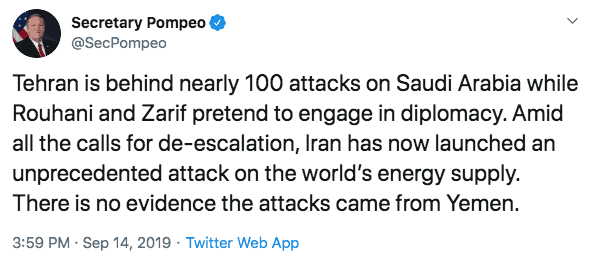
Although Iran’s Houthi rebel proxies in Yemen claimed credit for the drone and cruise missile attack, statements by U.S. Secretary of State Mike Pompeo and President Donald Trump instead pointed the finger of blame directly at the Iranian regime.

Specific details about the attack were sparse, though, until a detailed briefing by the National Council of Resistance of Iran (NCRI) at the National Press Club in Washington, D.C. on September 30, 2019. Citing “exclusive and top secret information sourced from inside the Iranian regime,” NCRI spokesman Alireza Jafarzadeh reported that the attack operation was directed from the very top levels of the Islamic Republic of Iran regime.

According to NCRI information, an extraordinary meeting of the Iranian Supreme National Security Council (SNSC) was held in Tehran on July 31, 2019, presided over by Iranian president Hassan Rouhani. Mohammad Javad Zarif, the Iranian foreign minister, is a regular member of the SNSC and also attended. A number of key Islamic Revolutionary Guard Corps (IRGC) commanders, not usually in attendance at SNSC meetings, were present at this one. Their presence is significant, not only for their central role in the attack two weeks later, but because they command the IRGC at the highest levels and include senior officers responsible for Iran’s IRGC aerospace force.

IRGC Major General Hossein Salami, who was appointed IRGC’s overall commander in April 2019, previously had served at the head of the IRGC Air Force, which has responsibility for Iran’s missile program.

Brigadier General Amir-Ali Hajizadeh, today the commander of the IRGC Aerospace Force, likewise was present at the July planning meeting. Hajizadeh appeared on a November 2018 Iranian TV program where, standing in front of a map of the Persian Gulf and SW Asia region, he explicitly threatened American military bases and naval forces, bragging that Iranian precision-guided missiles could strike any of them in a wide radius.

They are like pieces of meat before our teeth. If they do so much as move, we can hit them on the head,” he claimed.

IRGC Qods Force commander Qassem Suleimani also attended the July 31 meeting as did IRGC Major General Gholam-Ali Rashid, commander of the Khatam-ol Anbiya central military headquarters of Iran; he is responsible for operational coordination among all of the regime’s military forces, both IRGC and regular armed forces.

Iran’s Supreme Leader, the Ayatollah Ali Khamenei, approved the operational plans drawn up at the SNSC meeting, after which more detailed planning began.

On September 7, 2019, IRGC aerospace commanders deployed to Khuzestan Province in SW Iran, where they gathered at the Omidyeh base, situated between the cities of Ahvaz and Omidyeh. Omidyeh, formerly the regime’s Fifth Interceptor Base, from that point onward, became the operational base for the Saudi attack.

Additionally, a team of IRGC commanders with expertise in drones and missiles transferred from the IRGC’s Mahshahr naval base south of Ahvaz prior to the attack to lend their expertise to the operation. Ominously, according to Jafarzadeh, a new IRGC squad from its Aerospace Force arrived at the Omidyeh base from Tehran on Sunday, September 22, 2019. No additional information about its mission is yet available.

Against this backdrop of ratcheting tensions, the U.S., Saudis, and others in the region are walking a tightrope.

The Tehran regime has been pushing the limits of aggression for months now, testing whether it will ever be confronted with serious consequences because so far, it’s faced no real retaliation for attacks spanning decades.

The attack against the Saudi oil facilities on September 14 was unambiguously an act of war, not just against the Saudi Kingdom but the entire global economy that depends on the free flow of oil. But even though Iran has been credibly identified as the perpetrator, it has not yet seriously been held to account.

Speaking on the CBS program “60 Minutes” over the weekend of September 28-29, Saudi Crown Prince Muhammed bin Salman warned that unless Iran is deterred, it will only escalate its aggression until a real crisis breaks out that could see oil supplies disrupted and “oil prices [will] jump to unimaginably high numbers that we haven’t seen in our lifetimes.”

Speaking to Fox News on September 25, Saudi State Minister of Foreign Affairs, Adel al-Jubeir, also sounded the alarm against the Iranian regime, but appealed to the international community to take action, rather than threatening a unilateral response. Meanwhile, the Trump administration remains reluctant to get drawn into the gathering storm.

The Iran nuclear deal is dead and no amount of Iranian belligerence will bring it back. The question is how much Iranian belligerence will be tolerated and how will it be stopped.

Peter Pry: Iran probably already has nuclear weapons

Originally published by The Mackenzie Institute

Some in Washington want to bomb Iran for attacking Saudi Arabia’s oil fields.  But what if Iran has nuclear missiles?

Intelligence failure can kill thousands, as Washington learned on December 7, 1941, and should have learned again on September 11, 2001.  Intelligence failure in the nuclear missile age can destroy entire nations.

Washington officialdom believes Iran does not yet have nuclear weapons based on little more than wishful thinking and blind faith in an Intelligence Community deeply corrupted by the Obama Administration—and still unreformed by President Trump.

Three years ago, senior Reagan and Clinton administration officials warned that Iran probably already has nuclear weapons.  See “Underestimating Nuclear Missile Threats from North Korea and Iran” National Review February 12, 2016:

“Iran is following North Korea’s example — as a strategic partner allied by treaty and pledged to share scientific and military technology. Iran sacrificed its overt civilian nuclear program to deceive the Obama administration, to lift international sanctions, to prevent Western military action, while a clandestine military nuclear program no doubt continues underground. That is why Iran, under the nuclear deal, will not allow inspection of its military facilities and prohibits interviewing scientists — it is concealing the dimensions and status of Iran’s nuclear-weapons program.”

“We assess, from U.N. International Atomic Energy Agency reports and other sources, that Iran probably already has nuclear weapons. Over 13 years ago, prior to 2003, Iran was manufacturing nuclear-weapon components, like bridge-wire detonators and neutron initiators, performing non-fissile explosive experiments of an implosion nuclear device, and working on the design of a nuclear warhead for the Shahab-III missile.”

“Thirteen years ago Iran was already a threshold nuclear-missile state. It is implausible that Iran suspended its program for over a decade for a nuclear deal with President Obama.”

The above assessment is by Ambassador R. James Woolsey, President Clinton’s Director of Central Intelligence; Dr. William Graham, President Reagan’s White House Science Advisor, leader of NASA, and recently Chairman of the Congressional EMP Commission; Fritz Ermarth, a national security advisor to President Reagan and Chairman of the National Intelligence Council; and Ambassador Henry Cooper, former Director of the Strategic Defense Initiative.

These stellar intelligence officers, strategic thinkers, and scientists played major roles helping win the Cold War.  Perhaps we should listen to them now about Iran:

“Iran probably has nuclear warheads for the Shahab-III medium-range missile, which they tested for making EMP attacks…Iran already has the largest medium-range ballistic-missile force in the Middle East.”

“Iran could be building a nuclear-capable missile force, partly hidden in tunnels, as suggested by its dramatic revelation of a vast underground missile-basing system last year. Iran is building toward a large, deployable, survivable, war-fighting missile force — to which nuclear weapons can be swiftly added as they are manufactured.”

“And at a time of its choosing, Iran could launch a surprise EMP attack against the United States by satellite, as they have apparently practiced with help from North Korea.”

More recently, David Albright, former nuclear inspector for the UN International Atomic Energy Agency, and Ollie Heinonen, former Deputy Director General of IAEA, published an Institute for Science and International Security report based on Iran’s secret nuclear weapon archives clandestinely obtained by Israel’s Mossad:

“The archive shows that the AMAD program intended to build five nuclear warhead systems for missile delivery and possible use in preparation for an underground nuclear test; an actual test would require a decision to proceed. The program was also partially designed to have its own independent uranium mining, conversion, and enrichment resources. The documentation indicates that Iran’s nuclear weaponization efforts did not stop after 2003…”

“The United States incorrectly assessed with high confidence in a 2007 declassified National Intelligence Estimate (NIE) that ‘in fall 2003, Tehran halted its nuclear weapons program.’ Based on the information in the archives, Iran’s nuclear weapons program continued after 2003…Moreover, the 2007 NIE also incorrectly asserted that Iran had not re-started its nuclear weapons program as of mid-2007…However, there is no evidence that the program was ever fully halted, even up to today.”

“The information in the archive evaluated so far does not answer the question of what the current status of Iran’s nuclear weapons program is…”

Assessments that Iran does not yet have nuclear weapons assume erroneously: our intelligence is perfect, Iran’s civilian nuclear program is all there is, no clandestine nuclear weapons program exists in Iran’s numerous underground military facilities—including unaccounted uranium and plutonium facilities for fueling nuclear weapons, as in North Korea.

Where Iran is concerned, our Intelligence Community appears to have learned nothing from its spectacular failures grossly underestimating the nuclear threat from North Korea.  Does the Intelligence Community even want to know the truth about Iran’s Islamic bomb?

Reza Kahlili, the only CIA operative to successfully penetrate the scientific wing of Iran’s Revolutionary Guard, claimed Iran does have nuclear weapons and offered to procure photographs.  Obama’s Intelligence Community was not interested, and is still not interested

President Trump has inherited an Intelligence Community that disagrees with him about almost everything, including his decision to withdraw from the Iran nuclear deal.  According to the Intelligence Community, Iran is in technical compliance with the nuclear deal, officially the Joint Comprehensive Plan Of Action (JCPOA).

But if Iran already has nuclear weapons, Iran was never in compliance with JCPOA, and the Intelligence Community can chalk-up another major intelligence failure, potentially far more consequential than Pearl Harbor or 9/11.

If Iran has the bomb, why have they not yet attacked “the Great Satan” that is the United States?

Radical Islamist cleric Nasir al-Fahd’s May 2003 fatwa “A Treatise On The Legal Status Of Using Weapons Of Mass Destruction Against Infidels” may provide a clue.  Although al-Fahd is a Sunni sympathetic to al Qaeda, his rules for a nuclear holocaust against Infidels may well govern the thinking of the Shiite mullahs who run Iran too:

–First, under Islam’s “Just War Doctrine” the Infidels have to be given an opportunity to convert to Islam, before they can be destroyed.  This Iran’s leaders have done repeatedly, most prominently former President Mahmoud Ahmadinejad speaking at Columbia University (September 24, 2007) and at least twice at the United Nations (September 23, 2009 and September 26, 2012) about “the current world order based on injustice” and the virtues of the Islamic Republic of Iran.

–Next, a “final solution” against Infidels cannot be implemented except in a defensive war to protect the Ummah, the community or territory of Islam.  So a U.S. bombing campaign, especially one that threatens regime change in Iran, would justify nuclear annihilation of “the Great Satan”.

Is it possible Iran is deliberately trying to provoke the U.S. to attack, so the Mullahs can in “self-defense” come out of the nuclear closet by blasting a U.S. aircraft carrier, or making an EMP attack on North America?

By the way, “political correctness” under the Obama and Bush administrations, unfortunately continuing today, forbids the Intelligence Community from analyzing the ideology of radical Islam (the so-called “religion of peace”) for purposes of strategic warning or waging the Global War on Terrorism.  Consequently, the best and brightest counterterrorism and Islamist experts were purged from the Intelligence Community.

We should be treating Iran like a nuclear weapons state, with the same prudent caution used toward North Korea.  Let’s not learn the hard way that Iran already has its Islamic Bomb.

Appended to this article is a more comprehensive assessment of evidence Iran already has nuclear weapons that I wrote in 2016, drawing upon my training as a CIA Intelligence Officer and professional lifetime as a national security scholar.  Whether from bias or wishful thinking, compelling evidence Iran already has nuclear weapons, and warnings by prominent intelligence and national security experts from the U.S. and Israel, is largely ignored, as if this legitimate opinion is under a news blackout. 

Iran, Russia, and Turkey Will Influence New Syrian Constitution

On Monday, U.N. Secretary-General Antonio Guterres announced the formation of a “Syrian-organized and Syrian-led Constitutional Committee.” The committee will be comprised of 150 members with “a third picked by the regime, another by the opposition, and the remaining third by the United Nations.”

Formation of a committee was discussed earlier this month at a meeting in Ankara between the presidents of Turkey, Russia, and Iran. The committee is to be composed of individuals ranging from various factions such as, the Assad “government, opposition and civil society members.”

Russian President Vladimir Putin has asserted this project is important for Syria: “…the work of the constitutional committee will be decisive in finally normalizing the situation in the Syrian Arab Republic.” Very little information has been released so far.

This ambitious project proposed by the trio of authoritarians could be their way of exerting more influence and control over the Syrian government and its resources.

Moreover, the three governments (Iran, Russia, and Turkey) seeking to lead this effort are all egregious violators of human rights with immense disdain for democracy. Iran, Russia, and Turkey are some of worst abusers of human rights in the world, according to Freedom House.

Iran is a theocracy with majority of the political, executive, and military powers held by the Supreme Leader – currently Ayatollah Ali Khamenei, elected by the Assembly of Experts. The Ayatollah, along with the Assembly of Experts, have control of the country even though the President is the elected representative of the country, and the Supreme Leader’s decisions are rarely challenged. The Council of Guardians, half of whom are appointed by the Supreme Leader, determine the competency of individuals who can run for seats in Parliament and the Assembly of Experts.

In Iran, many journalists been sentenced to long terms in prison for simply reporting on events involving criticism of the Iranian government.

Turkey is democratic in name only. Technically, the President and Parliament are elected by the people. Under President Recep Tayyip Erdogan, the separation of powers has eroded and been replaced by an autocratic presidency. Following a reform of the Turkish Constitution, Erdogan reduced the legislative and judicial powers, successfully centralizing decision making. Twelve of the fifteen members of the Supreme Court are appointed by the President – and judicial oversight of the executive branch has been reduced. The Parliament can no longer challenge the President’s decisions, table a “vote of no confidence”, or approve cabinet ministers and other executive positions.

In Turkey, free speech is almost non-existent and it is illegal to criticize the president. News agencies, including Zaman and Daily Sabah,  once critical of Erdogan’s Administration were forced into a quasi-government takeover. The agencies were forcibly sold and now disseminate pro-Erdogan messages. This year, Turkish Opposition leader Canan Kaftancioglu, was sentenced to over 9 years in prison for criticizing the president and terrorism charge.  One of the offenses was criticizing Erdogan’s “government’s crackdown on 2013 Gezi Park protests and the killings of three Kurdish women activists affiliated with the outlawed Kurdistan Workers Party.”

In Russia, the President and the legislature are officially voted in by the people. There are individuals called “plenipotentiaries” who represent the President in each federal district and hold no constitutional powers. However, the President exerts overwhelming control of Russia’s political and administrative spheres. Putin punishes critics of his policies. It was reported that as of March 2019, there were “236 political prisoners” in Russian prisons while others have fled the country.

Mikhail Khodorkovsky, a human-rights activist and critic of Vladimir Putin, was imprisoned in Russia in 2003 for 9 years with a renewed sentence 12 years. He was later pardoned by Putin and fled to London. During his second trial, Khodorkovsky said that millions around the world would be “watching with the hope that Russia will after all become a country of freedom and of the law…Where supporting opposition parties will cease being a cause for reprisals…Where human rights will no longer depend on the mood of the Tsar.”

This initiative will further legitimize Bashar al-Assad, another serial human rights abuser.

Currently, there has not been a definitive allocation of duties for each group. It’s likely that Russia, Iran, and Turkey will be influential in the decisions of the Assad regime. Based on the composition of the constitutional committee, outcome of its efforts should be met with skepticism.

Iran Trying to Expand Influence Into Kashmir

This month, Mehr News Agency published an article about Iranian concern for Kashmiri civilians in the face of what they deem Indian oppression.

Tehran-based Mehr News Agency is owned and operated by an organization called the Islamic Ideology Dissemination Organization (IIDO). IIDO is the propaganda arm of the Islamic revolution of the Islamic Republic of Iran.

Kashmir is an Indian-administered territory that has been a subject of dispute between India, Pakistan and China. Islamists, like Lashkar e Taiba, backed by Pakistan, have attempted to seize the territory for decades.

Iran is attempting to lead the entire Islamic world, despite historic Shiite-Sunni tensions. Kashmiri Muslims are Sunni, but Shiite Tehran has frequently worked with Sunni groups:

  • Iran is the chief sponsor of the Sunni terrorist group Hamas which weeks to replace Israel with an Islamic state ruled by Sharia. This is consistent with Iran’s other efforts to provide Sunni terrorist groups with weaponry and training.
  • Iran has defense agreements with the Sunni regime in Sudan, a fellow state sponsor of terrorism.
  • Iran—and its Shiite terrorist proxy Hezbollah in Lebanon – have periodically provided safe haven, training, and arms to al Qaeda, a Sunni terrorist group.
  • According to US military leaders in Afghanistan, Iran has provided weaponry and support for the Taliban, which is Sunni.

Iran may be using the Kashmir conflict to get closer to Pakistan. This could be a game changer because traditionally, the Pakistanis (80% Sunni) have not been interested in working with the Iranians. A Pakistani-Iranian alliance would be very beneficial to Iran and could possibly include a transfer of Pakistani nuclear technology.