Tag Archives: Keeper of the Flame

2008 Keeper of the Flame Award: Jack Keane

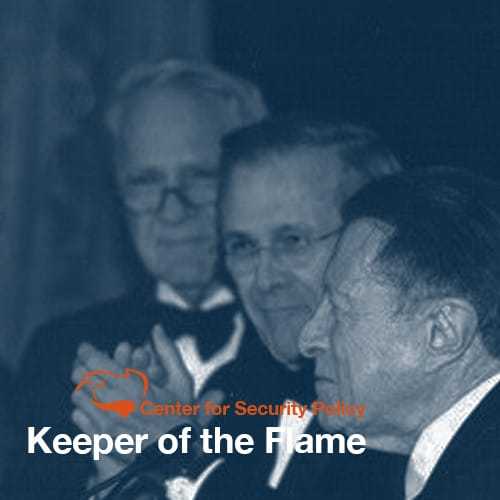
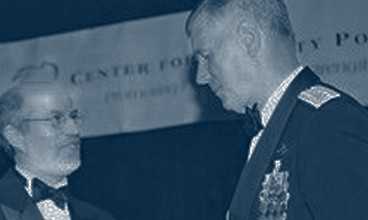
On a breezy September night in Washington, the Center for Security Policy hosted its annual Keeper of the Flame Award dinner; this year’s honorees were the “Heroes of the Surge,” men and women who heroically changed the shape of the Middle East this year. The elegant gala was held at the venerable Union Station, and coincided with the 20th anniversary of the Center; longtime friends and comrades from Cold War-era policy battles joined new faces in the service of “peace through strength.”

Nearly 400 attended the elegant black tie gala, which coincided with the twentieth anniversary of the Center’s founding in 1988. As is characteristic of this organization and its founder and president, Frank Gaffney, grand retrospectives were deferred in favor of looking to the battles ahead.

Last winter, original supporters of the Iraq war were tough to find; the press soberly related the chaos in that country and public figures, like the Senate Majority Leader, pronounced definitively that, “this war is lost.”

At the same time, recently-retired four-star general Jack Keane, together with Fred Kagan, a resident scholar at the American Enterprise Institute, published “Choosing Victory: A Plan for Success in Iraq.” The paper sketched a revised strategy in the war, with greater emphasis on aggressive counter-insurgency and “clearing, holding and building” after the enemy is driven out of a region. The plan also called for 15,000 more troops. President Bush committed his legacy and his popularity at home to this ‘Surge’; he had faith that armed with a new blueprint for winning the war, the armed forces of the United States was up to the task.

Perhaps the best measure of the effectiveness and success of the Surge is how the Iraq war has faded from constant play in the media. Once a liability for the president and his party, victory in the war today is taken for granted.

The Center for Security Policy took great pleasure in honoring those who took part in the Surge, their families, the visionary leaders who recognized the need for this initiative and who steadfastly supported its execution, supporters of the surge here on the homefront and those in Iraq who are playing an increasingly important role in consolidating their nation’s liberation.

In bestowing this year’s Keeper of the Flame Award to General Keane, Frank Gaffney acknowledged the general’s “strategic vision, his leadership skills and his dedication to the security of this nation that have contributed significantly to Iraq’s ever-more stable present and increasingly hopeful future.” As the Vice Chief of Staff, Gen. Keane helped lead the Army in Afghanistan and Iraq; his leadership was indispensable to the service’s efforts to transform itself into a more agile and rapidly deployable force.

Both President Bush and Gen. David Petraeus sent touching and emotional prerecorded messages in the general’s honor.

Douglas Feith, a longtime friend of the Center and former Undersecretary of Defense, signed copies of his best-selling memoir War and Decision.

In addition to Gen. Keane, five others were recognized as Heroes of the Surge. They were:

  • William Luti, representing the Bush Administration. He is Special Assistant to the President and Senior Director for Defense Policy and Strategy.
  • Fred Kagan of AEI, co-author (with Gen. Keane) and ‘architect’ of the Surge, and formidable military policy expert and historian;
  • Merrilee Carlson of Families United for Our Troops and Their Mission—a grassroots coalition of Gold Star and Blue Star families, veterans and Americans who share a deep appreciation for our men and women in uniform;
  • Pete Hegseth is a veteran of Iraq and the chairman of Vets for Freedom, a nonpartisan organization established to educate the American public about the importance of supporting our troops and giving them what they need for victory;
  • Sergeant Gabriel Herrera, who, in his first deployment, became a recipient of the Purple Heart, due to injuries sustained from an IED blast to his vehicle. After redeploying in support of the Surge, Sergeant Herrera provided direct support to General Petraeus with the 177 Military Police Brigade; and
  • Zainab Kassem Mohammad al-Tememe was 21 years old when she decided she wanted to help the Americans. Unable to stand by while her country slid into chaos, she exposed herself to tremendous danger and walked to contractor’s offices in Baghdad in late 2004 asking to be hired as an interpreter. Since then she has worked with the Marine’s in Faluja and Diwaniyeh and with Special forces in Hillah.

2007 Keeper of the Flame Award: Joe Lieberman

At the 2007 Keeper of the Flame Award dinner, the Center for Security Policy paid tribute to Senate Homeland Security and Governmental Affairs Committee Chairman Joseph Lieberman (I-CT) and Defenders of the Home Front – the men and women who work daily to keep us and our families safe here at home.

Senator Lieberman’s address to the nearly 350 attendees at this elegant black-tie dinner held at Washington’s landmark Union Station was preceded by a welcome from Mr. Linden Blue, Vice Chairman of General Atomics, and remarks by The Honorable Francis Fragos Townsend, White House Homeland Security Advisor. The Keeper of the Flame Awards were presented to Senator Lieberman by Senator Jon Kyl (R-AZ), and to five outstanding representatives of Defenders of the Home Front by Senators Lieberman and Kyl.

The event featured remarks by Senator Lieberman during which the Senator noted the need for vigilance in guarding against the forces that threaten American security: “…We must always listen for and look for and be attentive to the future threats to liberty and be ready with all the power we can marshal to rise in defense of our security and our liberty, because in the words of the great abolitionist and fighter for freedom, Wendell Phillips, later made famous in our time by Barry Goldwater, ‘Eternal vigilance is the price of liberty.’  That vigilance, that principle is obviously not a Democratic or Republican principle.  It certainly is not and should not be a conservative or liberal cause, for defending the ideals of human  liberty is America’s cause, and it is a cause we must put ahead of party or faction…”

Senator Lieberman went on to pay tribute to members of the United States Armed Forces fighting overseas: “I am greatly honored to accept this award tonight, but I want to say quite sincerely that I share it with the true keepers of the flame of liberty, and that is the brave men and women who defend our liberty on the battlefields of Iraq and Afghanistan today. Their sense of purpose is high. Their honor is deep. Their commitment to American principles is strong, and their confidence that what they are doing is right and they can succeed in it is contagious.”

The six Defenders of the Home Front honorees were:

Special Agent John Guandolo of the Federal Bureau of Investigations:   A decorated U.S. Marine combat veteran of Desert Storm, Special Agent Guandolo has worked in the FBI since 1996 including nine years as a member of its SWAT team.  Since shortly after 9/11, he has worked in the Bureau’s Washington Field Office’s Counterterrorism Division, developing a legendary expertise concerning Al Qaeda, Muslim Brotherhood organizations and the broad subversive Islamist movement in the U.S. Special Agent Guandolo was recognized for his efforts to educate his colleagues and others in the law enforcement and intelligence communities about these subjects.

Brian Morgenstern: While working at an electronics store in New Jersey, Brian Morgenstern became alarmed when he watched the video that two men brought him to transfer to a DVD. Seeing the men in the video firing automatic weapons and shouting “Allah akbar” he contacted police. Thanks to his courageous, public-spirited action, six Islamists suspected of preparing deadly attacks at Fort Dix on U.S troops bound for Iraq, were arrested and are now being prosecuted in connection with the plot.

Captain Thomas Jones, U.S. Coast Guard, Commanding Officer, Coast Guard Research & Development Center, Groton, Connecticut. Under Capt. Jones’ leadership, the R&D Center has played a leading role in developing and providing Port Security Risk Assessment Tools crucial to protecting port infrastructure and a sophisticated software system to coordinate multi-agency response to catastrophic events and massive oil spills. These initiatives are a credit to the men and women under Capt. Jones’ command and to their leader.

A Posthumous award to Hany Aziz Iskandar accepted by his widow, Judy Iskandar. Hany was an example of one of the most unsung of heroes in this War for the Free World — those whose language skills enable them to understand, monitor and penetrate enemy organizations. He provided various U.S. government agencies incisive understanding of the Muslim Brotherhood and other Islamist organizations in this country and overseas. His work contributed to the successful prosecution of convicted terrorists such Abdurahman Alamoudi.

Sergeant Roy Jordan Ramsey representing the Joint Force Headquarters, National Capital Region.   Sgt. Ramsey is a combat veteran of Iraq currently assigned to the Old Guard, the Army’s fabled 3rd Infantry Division. Northern Command’s Joint Force Headquarters for the National Capital Region was created after 9/11 for the sole purpose of preventing and responding to future terrorist attacks within the Washington, D.C. area and its surrounding cities and counties. Its successes include several stymied terror plots and containing the ricin incident on Capitol Hill on February 2, 2004.

Dr. M. Zuhdi Jasser, Founder and Chairman of the American Islamic Forum for Democracy (AIFD). Dr. Jasser exemplifies the sort of courageous, anti-Islamist Muslims sorely needed by this country and the world.   Dr. Jasser was recently featured on Fox News during a special built around the film produced in part by the Center for Security Policy: “Islam vs. Islamists – Voices form the Muslim Center.”

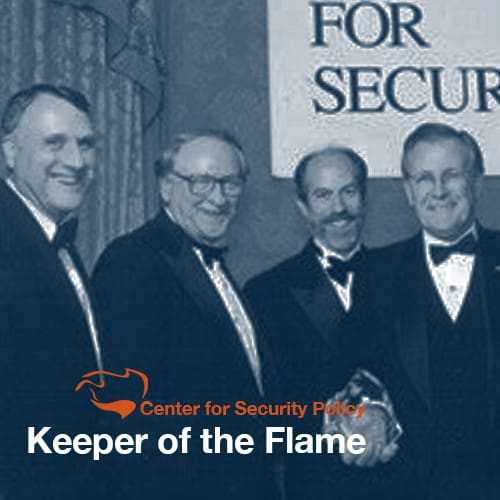
PHOTO ABOVE: Frank Gaffney, Special Agent Guandolo, Brian Morgenstern, CAPT Tom Jones USCG, Sen. Jon Kyl, Judy Iskandar, SGT Roy Ramsey, Dr. Zuhdi Jasser, and Sen. Lieberman pose together after the award ceremony.


Crass test Dems

The following article, by Senator John Kyl (R-AZ), appeared today in the National Review Online.  Senator Kyl was the Center’s 1994 Keeper of the Flame awardee. 

For the past two weeks, the U.S. Army has been scrambling to find the money to support our troops in he field because of Democrats’ decision to delay the emergency war supplemental-spending bill to score political points.

A month ago, when the Senate first took up the president’s emergency funding request, military leaders warned that failing to finish the supplemental by April 15 would force the Army to begin cutting back on things like troop training and equipment. Despite this warning, Democrats insisted on delaying the bill by including an arbitrary deadline for withdrawal from Iraq, a provision they knew would guarantee a presidential veto.

Then, instead of immediately reconciling the House and Senate versions of the bill and getting a final bill to the president so it could be returned to Congress for reconsideration, House leaders delayed appointing conferees for almost three weeks—three weeks during which the deadline for getting this funding to the troops came and went. Democrats finally passed the conference report, but they have now further delayed matters by waiting until April 30 to send the bill to the president. Could it be this was intended to score political points by having its arrival coincide with the anniversary of the president’s "mission accomplished" speech?

Meanwhile, while the Democrats delay, the Army has had to start cutting back on non-essential equipment repair and training to ensure it is able to fund our troops in the field and provide support to their families. Plans are also underway to temporarily redirect money from Navy and Air Force pay accounts to the Army’s operating account to support our troops in Iraq.

If the Army fails to receive the money by May, it will be forced to take more drastic measures, including freezing new civilian hiring, releasing temporary employees, and canceling orders for parts, supplies, and services. An April 16 release from the Army notes that "[t]hese actions carry consequential effects, including substantial disruption to installation functions, decreasing efficiency and potentially further degrading the readiness of non-deployed units."

Setting arbitrary deadlines for withdrawing from Iraq is dangerous policy. It tells the terrorists that all they have to do is wait us out. It tells our troops that their efforts will not matter, since we will pull out of Iraq no matter what successes they have on the ground. And it tells the Iraqi people that we are not really committed to standing with them as they seek to reclaim their country.

Our new strategy has shown early signs of success precisely because the Iraqi people have seen that we are committed to standing with them for the long haul. Previously our troops would enter an area, subdue it, and then pull out, allowing the terrorists to come back in. Now, our troops enter an area, subdue it, and then, with Iraqi troops, stay there to prevent the terrorists from returning.

A recent column in the Los Angeles Times illustrated the progress we’re making in Ramadi, where the Army has begun implementing our new strategy. Beginning last year with a build-up of U.S. forces near al-Qaeda strongholds in the city, U.S. soldiers and Marines joined Iraqis in an offensive to gain control of Ramadi. Throughout the process, U.S. troops established a number of bases and observation posts throughout the city to prevent the insurgents from returning.

The results of these efforts have been encouraging. Attacks have dropped from approximately 20 to 25 a day to two to four a day, and enlistment in the police force is increasing. The whole of Al Anbar province has seen marked improvement of late: Tips to Coalition forces have risen significantly, U.S. troops are defusing 80 percent of IEDs before they can explode, and attacks have reached their lowest point in two years. Announcing we are going to pull out in less than six months, no matter what the situation on the ground, would dishearten our Iraqi allies and undo much of the progress we have made.

Pulling out of Iraq now would jeopardize our national security and endanger the Iraqi people. If the terrorists feel they have defeated us in Iraq, they will not hesitate to attack us elsewhere. Pulling out of Iraq would also likely result in a civil war that would cost hundreds of thousands of innocent people their lives. We have an obligation to try to make sure the Iraqi government is as stable and secure as we can make it before we leave Iraq.

It is unconscionable to hijack the security supplemental funding bill to make a political point while the Army struggles to find the money to support our troops — but this is exactly what Democrats, through their delay tactics, have done. Congress needs to act immediately to send a bill to the president that funds our troops while leaving military strategy to our commanders on the ground.

2006 Keeper of the Flame Award: Duncan Hunter

On September 20, 2006, the Center for Security Policy paid tribute to House Armed Services Committee Chairman Duncan Hunter and Those Who Serve – the men and women who render invaluable service to the Nation in the War on Terror.

Congressman Hunter’s address to the nearly 400 attendees at this elegant black-tie dinner held at Washington’s landmark Union Station was preceded by a welcome from Dinner Chairman Jim Pitts, Corporate Vice President of the Northrup Grumman Corporation, and remarks by Secretary of Defense Donald Rumsfeld.  The Keeper of the Flame Awards were presented to Rep. Hunter and five outstanding representatives of Those Who Serve in the U.S. armed forces by House Appropriations Committee Chairman Jerry Lewis and Chairman of the Joint Chiefs of Staff General Peter Pace,
respectively.

The event featured a moving video tribute produced by Renegade Productions to one of America’s great patriots, former Reagan Secretary of Defense and the first recipient of the Keeper of the Flame AwardCaspar Weinberger, Sr.  Fittingly, Caspar Weinberger, Jr. was on hand to pay tribute to those honored in his father’s last book (which was completed shortly before his death this past spring), entitledHome of the Brave.  The volume tracks the stories of several of nineteen of today’s military heroes, four of the five of whom were recipients of Flame awards in recognition of their service and on behalf of all those who serve in their respective military branches.  The five servicemen honorees were:

  • Sergeant Michaeux Sanders, USA.  On April 4, 2004, on what was suppose to be his last day in Iraq, then-Specialist Micheaux Sanders and his unit were called to the aid of a patrol trapped in an ambush by Iraqi insurgents. During the battle, a round struck Sanders in the arm, slicing straight through his shoulder and out the other side, but he continually waved off the medics who tried to come to his aid. Fighting furiously but low on ammunition, Sanders repeatedly exposed himself to the enemy, firing whatever weapons he could find, and helping save several of his fellow crewmembers.  Sergeant Sanders was awarded the Silver Star.
  •  Captain Brian Chontosh, USMC.  Caught in an ambush in Iraq, Chontosh ordered his vehicle’s driver to advance directly at the enemy position enabling his .50 caliber machine gunner to silence the enemy.  Chontosh then directed his vehicle into the enemy trench, and began to clear it. His ammunition depleted, Chontosh, with complete disregard for his safety, twice picked up discarded enemy rifles and cleared over 200 meters of the enemy trench, and disrupted the ambush.  Captain Chontosh was awarded the Navy Cross.
  •  Hospital Corpsman Third Class Luis Fonseca, USN.  In Nasiriyah Iraq, during a battle with the Saddam Fedayeen, Fonseca raced through mortar, rocket-propelled grenade and small arms fire tending to wounded Marines, even carrying an injured Marine twice his size on his back for over two hundred yards to bring him to safety. After his brave dash and continuous deadly artillery barrages, Fonseca repeatedly exposed himself to enemy fire to treat Marines wounded along the unit’s perimeter and was able to evacuate them to safety.  Corpsman Fonseca was awarded the Navy Cross.
  • Technical Sergeant Stephen Achey, USAF.  During Operation Anaconda, March 2002, in the frigid, icy mountainous terrain of the Shahikot Valley in Afghanistan, then-Staff Sergeant Stephen Achey’s job was to call in precision air strikes on enemy targets.But when his team was ambushed by a hurricane of Al Qaeda and Taliban fire, a mortar blast damaged his communications equipment.  Springing to his feet and running at top speed, Achey was able to retrieve another radio.  He then alternated between the radio and his rifle to orchestrate gunship and fighter attacks that destroyed numerous enemy positions and facilitated the extraction of his wounded brothers in arms.  Sergeant Achey received the Silver Star.
  •  Lieutenant Junior Grade Bradley Middleton, USCG. In June 2005, LTJG Middleton assumed the duties of Executive Officer of the US Coast Guard Cutter Maui, deployed to the Arabian Gulf in support of Operations Iraqi Freedom and Enduring Freedom.  Over the course of this one-year tour, LTJG Middleton spent over 5,000 hours underway in Iraqi waters and completed approximately 100 vessel boardings in order to ensure the security of coalition forces and assets off the coast of Iraq.

Among those in attendance from the Administration for the seventeenth annual Keeper of the Flame Award were: Deputy National Security Advisor J.D. Crouch; Homeland Security Advisor to the President Fran Townsend; Senior Director of Defense Policy and Strategy at the National Security Council William Luti; Undersecretary of State for Arms Control and International Security Robert Joseph; Assistant Secretary of State for Verification and Compliance Paula DeSutter; Deputy Assistant Secretary of Defense for Stability Operations Jeffrey Nadaner; and Deputy Assistant to the President for Homeland Security Ken Rapuano; as well as Senators Jon Kyl and James Inhofe, the 1994 and 2005 Keeper of the Flame Award recipients, respectively.

Other distinguished guests included: Supreme Allied Commander, Europe, Gen. James Jones, James Cartwright USMC and Gen. Norton Schwartz, Commander, U.S. Transportation Command; former Undersecretary of Defense for Policy Doug Feith; and former National Counterintelligence Executive Michelle Van Cleave. USMC; Commander of Strategic Command Gen.

The event concluded with moving remarks by Westwood One’s nationally syndicated talk show host Lars Larsen, who recently lost a close friend in combat in Iraq.  Mr. Larsen joined in thanking Congressman Hunter and all Those Who Serve, and encouraged their support through the work of the Center for Security Policy.

Caspar W. Weinberger, R.I.P.

Early this morning with the passing of former Secretary of Defense Caspar W. Weinberger, the Nation lost one of its most accomplished public servants and skilled practitioners of the philosophy of “peace through strength.” The Center for Security Policy, which recognized Secretary Weinberger’s tremendous contribution to America’s security by bestowing upon him its first “Keeper of the Flame” Award in 1990, mourns his loss at a time when his clarity of vision, steadfastness of purpose and tenacious commitment to principle are needed more than ever.

A decorated combat veteran of World War II and graduate magna cum laude of Harvard College and Harvard Law School, Mr. Weinberger went on to serve as Chairman of the Federal Trade Commission, Director of the Office of Management and Budget, and Secretary of Health, Education, and Welfare.

It was as President Ronald Reagan’s Secretary of Defense from 1981 to 1987, however, that “Cap” Weinberger made his most notable contributions to the Nation’s well-being, with his leadership – indeed, his personification – of the Reagan effort to rebuild America ‘s military and to assume once again for the United States the role of leader of the Free World. Undoubtedly, history will recognize that his stewardship in the modernization and strengthening of America ‘s armed forces was indispensable to the success of the Reagan strategy for destroying the Soviet Union and for promoting freedom in every corner of the world.

The Weinberger legacy has been tangibly evident in another area, as well: America ‘s extraordinary successes on the battlefield over the past two decades have been a direct result of the reinvestment in our forces and their hardware undertaken on Cap’s watch . Had it not been for his determined advocacy and competent oversight, we may have been less able to draw upon the mainstays of our military power today and tomorrow – from the M-1 main battle tank to the Bradley Fighting Vehicle to the B-1 and B-2 bombers to the V-22 tiltrotor to the Trident submarines to the Global Positioning Satellite system – to project power flexibly, precisely and decisively.

Secretary Weinberger will also be remembered for the seminal role he played in shifting the national paradigm from one of deliberate vulnerability to ballistic missile attack to one in which anti-missile defenses are part of a comprehensive homeland security posture. Thanks in no small measure to the groundwork laid by President Reagan and his cherished friend and loyal defense secretary, President George W. Bush recognized the need to deploy missile defenses and took the steps necessary to accomplish that goal. Most important of these was his decision to withdraw from the 1972 Anti-Ballistic Missile Treaty, an action Mr. Weinberger championed with characteristic vision, eloquence and tenacity for the better part of two decades, both in and out of government.

Center President Frank J. Gaffney, Jr. observed on learning of Secretary Weinberger’s passing:

The Nation has lost today one of its most formidable national security practitioners. Caspar Weinberger worked tirelessly and with distinction and dignity in a lifetime of public service and private sector leadership. He was a gentleman of the first order, inspiring in his subordinates unflagging loyalty and deep affection and in his adversaries – foreign and domestic – genuine, if often grudging, respect.

The greatness of the President Secretary Weinberger served was in considerable measure a product of the extraordinary quality of the men and women in whom he entrusted the well-being and security of the American people. Second to none in that regard was Cap Weinberger.

The Center for Security Policy mourns as well the loss today of another key member of President Reagan’s team, Lyn Nofzinger. It joins with all the other members of that community in extending to his family and that of Secretary Weinberger our deepest condolences and profound thanks.

2005 Keeper of the Flame Award: James Inhofe

On Wednesday October 20, 2005, the Center for Security policy paid tribute to the Heroes of the Homefront – the men and women who render invaluable service in defending our homeland and supporting our soldiers oversees. Accepting the Keeper of the Flame Award on their behalf was Senator James Inhofe.

Senator Inhofe’s address to the 350-plus attendees at this elegant black-tie dinner held at Washington’s landmark Union Station was preceded by a welcome
from former Director of the Central Intelligence Agency James Woolsey. Sen. Inhofe was introduced by Deputy National Security Advisor J.D. Crouch.

Among those in attendance for the sixteenth annual Keeper of the Flame Award were: Homeland Security Advisor to the President Fran Townsend; Undersecretary of State for Arms Control and International Security Robert Joseph; National Counterintelligence Executive Michelle Van Cleave; Assistant Secretary of State for Verification and Compliance Paula DeSutter; Senior Director of Defense Policy and Strategy at the National Security Council William Luti; and Deputy Assistant Secretary of Defense for Western Hemisphere Affairs Rogelio Pardo-Maurer.

Members of Congress in attendance included: Senator Conrad Burns; Congressman J.D. Hayworth; Congressman Roscoe Bartlett; Congressman Robin Hayes; Congressman Charles Taylor; and Congressman Geoff Davis.

Other distinguished guests included: Chairman of the U.S.-China Economic and Security Review Commission Dick D’Amato; Chairman of the Broadcasting Board of Governors Kenneth Tomlinson; former Chairman of the Defense Policy Board Richard Perle; and former Senator Tim Hutchinson.

Organizations and individuals specifically honored for their efforts on the Homefront were:

    •  Karen Theobald-Conlin, President of Helping our Heroes Foundation, which provides mentors, patient advocates, counseling and assists with emergency funding needs for our wounded veterans for Iraq and Afghanistan.
    •  Lt. Bob Fromme of the Iredell County North Carolina Sheriff’s Department who in working with the FBI and the Bureau of Alcohol, Tobacco, and Firearms uncovered at multimillion-dollar tobacco smuggling ring which was raising money for Hezbollah.
    •  Peter Gadiel of the 9/11 Families for a Secure America who have worked to hamper terrorist activity by pursuing the 9/11 Commission observation “that terrorists cannot plan and carry out attacks in the United States if they are unable to enter the country.”
    •  Jim Weiskopk the VP for Operations of the Fisher House which operates at least one Fisher House at every major military medical center and annually provides over 8,500 military families with a supportive home environment as their loved ones are recovering from injury or illness.
    •  Jim Schwartz, Chief of the Arlington County Fire Department whose members heroic actions during the 9/11 attack on the Pentagon to their recent rescue efforts in New Orleans have been marked by professionalism, courage, and caring.
    •  Mayor Ernie Currier of Enid, Oklahoma which was the first community to officially join the Defense Department’s “America Supports You” program, and has recruited over 20,000 Enid residents to join the effort in a number of ways, including sending letters, books, magazines, DVDs and other items to the service members overseas.
    •  Gen. Paul Vallely who though the Scott Vallely Soldiers Memorial Fund conducts holiday gift drives for service members and is building a Fallen Heroes statue to pay tribute to his son Scott and all those men and women who have given their lives in the service of our nation.
    • Debra Burlingame, sister of Charles F. “Chic” Burlingame, the pilot of the plane that was crashed into the Pentagon by terrorists on September 11, 2001 who though her intrepid, inspiring and courageous leadership of thousands of other 9/11 family members has ensured the hollowed ground at the site of the World Trade Center, will memorialize for future generations what happened to America on that terrible day.

In a moving presentation, Gen. Paul Vallely and his wife Muffin presented to the Center a scale model of a statue commemorating the sacrifices of our fallen heroes on behalf of the Scott Vallely Soldiers Memorial Fund.

The event concluded with remarks by 1994 Keeper of the Flame Award Recipient Senator Jon Kyl, who joined in thanking Sen. Inhofe and the men and women he represented on this occasion, and encouraged their continued support through the work of the Center for Security Policy.

General Peter Pace: Why we serve

Decision Brief     No. 05-D 18                                        2005-04-21


(Washington, D.C.): The Center for Security Policy is delighted by President Bush’s reported intention to nominate the current Vice Chairman of the Joint Chiefs of Staff, Marine Gen. Peter Pace to be the Nation’s senior military officer as that organization’s next Chairman.


The Center has long believed that General Pace is an exceptional human being and a remarkable leader of men and women. These qualities were much in evidence last October when General Pace accepted the Center for Security Policy’s 2004 “Keeper of the Flame” Award on behalf of the Defenders of Freedom.


In extemporaneously delivered remarks on that occasion, the next JCS Chairman delivered one of the most extraordinary addresses in memory. Highlights of his address, which spoke movingly about the reasons the Defenders of Freedom serve as they do included the following:


  • “If you go to Iraq or Afghanistan and you look [great young men and women in the field] in the eye they will not ask you about personal things. There may be one or two questions about when that unit might be going home. That’s natural. What they want to know is: are the American people behind us? They want to know that what they are doing is as honest and as good, and is recognized to be as honest and as good, as they understand it to be. They get it.

They may not be thinking every night about their oath, but they understand because they’re living amongst people who have never understood freedom, and are living in an environment that reminds them every day of how lucky each of us is to be an American and how wonderful it is to serve this country. They just want a little assurance every now and then that the folks back home appreciate it….


  • A vital part of who we are as your military is our families. Now when you’re in combat you have days that are really intense and there are days that are very dangerous, but you know when you’re in trouble and you can fight your way out of it. Our families don’t know that. If we’re gone a year, our families every day are thinking today their son, their daughter, their husband, their wife, their mom, their dad is being shot at or is in some kind of danger. In Pete Pace’s mind it is so much more difficult to be a family member than it is to be the one in uniform. We owe our families an incredible debt. My wife and daughter are here tonight; there’s no way that I can thank them. Jim Jones’ wife and son and daughter-in-law are here tonight. There’s no way he can thank them. But these families of ours are patriots in a quiet, strong way that promises the tomorrow that we all strive for….


  • [Supreme Allied Commander General] Jim Jones has said some amazingly nice words tonight. I am probably the only guy in the room, who truly knows in his heart of hearts, I do not deserve those words. I stand before you tonight because in 1968 and 1969 young men – Lance Corporal Guido Farinaro, Lance Corporal Chubby Hale, Corporal Mike Witt, Lance Corporal Whitey Travis, Staff Sergeant Willie Williams, Lance Corporal Little Joe Arnold — and the list goes on. Those men took my orders in combat and as a result, died for their country. I owe them a debt I can never repay.

People say to me today, how do you do it? The implication being there’s some burden here. This is not a burden. This is a privilege to serve this country, to do it in their honor and their memory.


I will accept this award tonight in their memory and the memory of all who have served this country and died, and in tribute today and tonight for the incredibly wonderful young men and women who serve our country right now.


I thank you for this opportunity to publicly say to them we love them, we cherish them, and we support them.

Kasparov warns of Putin’s threat to freedom

In the 1980’s, World Chess Champion Garry Kasparov used his enormous prestige in the former Soviet Union to help bring down the Communist regime and to free the people it had enslaved. For his courage in defying the Kremlin and rallying opposition to it both inside the USSR and throughout the West, the Center for Security Policy in 1992 proudly conferred upon him its prestigious "Keeper of the Flame" Award.

Today, Mr. Kasparov is once again warning of the danger to the Russian people and to the wider world of a Kremlin bent on crushing freedom and expanding its authoritarian reach to the so-called "Near Abroad" and beyond. Most recently, he penned a powerful op.ed. column in Tuesday’s Wall Street Journal entitled, "Say It in Russian: ‘Caveat Emptor.’"

Among Mr. Kasparov’s most compelling observations were the parallels he perceives between Vladimir Putin’s agenda and that of previous emerging totalitarians. For example, he warned:

    Those who think they can influence Mr. Putin’s course by supporting him will see that accommodation won’t be any more successful here than giving the Olympic Games to Berlin was in 1936. Treating dictators kindly doesn’t soften a regime; it only makes it more arrogant and aggressive.

Particularly noteworthy is Garry Kasparov’s clarion call about the fascistic tendencies of the Putin regime – and their implications for Western behavior:

    Perhaps Western leaders agree with last week’s New York Times editorial that made the stunning assertion that "a fascist Russia is a much better thing than a Communist Russia." I hope I am allowed to order something not on that menu. I am not ready to throw up my hands and surrender to the Putin dictatorship. It is still possible to stand up to the dictator and to fight for democracy.

    In March, 1991, then-President George H.W. Bush and his European counterparts were still supporting Mikhail Gorbachev’s futile domestic endeavors. I wrote then that if we were left alone we would soon have no Gorbachev and no communism. Now we need to say no to Vladimir Putin and no to fascism. If the United States and the European powers are not willing to help us in this new fight, at the very least they should stay out of the battle and stop giving aid to the forces of fascism. (Emphasis added throughout.)

Say It in Russian: ‘Caveat Emptor’
By GARRY KASPAROV
The Wall Street Journal, 21 December 2004

If the West won’t stand up for basic human rights and democratic principles in Russia, one last hope was that it would come to the aid of free enterprise. But the only voice of protest against this weekend’s auction of Russian oil giant Yukos’s main asset came from Texas, and it wasn’t George W. Bush — it was a bankruptcy court in Houston. Needless to say, the auction of Yuganskneftegaz went forward on Sunday in Moscow despite the court order.

With the Russian state gas company Gazprom in a potential legal tangle over the injunction, the auction was won by a completely unknown entity from the Russian hinterlands that just happened to have $9.3 billion cash on hand. This company will soon prove to be the outer layer of a Russian matryoshka doll. We’ll find a Gazprom doll inside of that one and, like every matryoshka today, at the center will be Vladimir Putin.

* * *

If you are looking for a guide to the future of Russia, you need only listen to the words of President Putin. Listen carefully — and then take it for granted that the exact opposite will happen. One of the more lurid ways in which Mr. Putin’s Russia is coming to resemble ’30s-era Germany is this Orwellian doublespeak.

Adolf Hitler’s improbable mantra was "We want peace." Mr. Putin’s recent statements have proven equally truthful. "We won’t touch the Constitution" has been followed by one antidemocratic power grab after another. Elected regional governors have been abolished in favor of Kremlin appointees. Now even more power is being centralized as the nation’s natural resources are being put under direct federal control.

In case the changes to the constitution aren’t enough to satisfy the Kremlin, there is now a law moving forward that will allow the constitution to be suspended at will by the FSB — which is proudly showing its KGB roots — if they assert that there is threat of a terrorist attack. To criticism they say that America is "doing the same." Do not think for a moment that this is a fair comparison; equating the recent actions of the Russian parliament with the Patriot Act is like saying that chopping off your hand is similar to trimming your nails.

At the start of the Beslan terrorist crisis, Mr. Putin said in a meeting with Jordan’s King Abdullah that the well-being of the children was the top priority. A day later security forces attempted an assault and hundreds died. Mr. Putin likewise said that the government had no intention of letting Yukos go bankrupt.

Even more shameful is how little the so-called leaders of the free world have said and done in response to these attacks on the truth. While polls inside Russia can’t be trusted, Mr. Putin can count on votes of confidence from Silvio Berlusconi, Tony Blair, George Bush, Jacques Chirac and Gerhard Schroeder. Perhaps Mr. Schr?der and the others are afraid of losing their visas under another new law being contemplated by the parliament that will allow them to deny entry to any foreigner who "shows disrespect" for Russia. Meanwhile, Mr. Bush stubbornly called "Vladimir" his "good friend" at a press conference yesterday.

Capital is traditionally shy of joining such dubious enterprises as this weekend’s dismantling of Yukos. To participate in this state-run racketeering operation is no better than investing in the Chicago Mafia of Al Capone. Let us name the names of the Western entities that saw fit to fund Gazprom’s bid and thus endorse the looting of Yukos: Deutsche Bank AG, ABN Amro Holding NV, BNP Paribas SA, Dresdner Kleinwort Wasserstein and J.P. Morgan Chase & Co.

But at least their employees are safe, unlike those of Yukos, dozens of whom are currently being persecuted — either in jail, under investigation, or on the run. All of this to settle a Kremlin vendetta against Yukos head Mikhail Khodorkovsky and to send a message to other industry leaders that they had better toe the line if they want to keep their businesses and remain free.

The latest example of this trend is the harassment of Russian mobile-phone operator VimpelCom. They are being targeted much in the same way as Yukos. The company has been hit with tax bills totaling over $450 million dollars. It comes as no surprise that the owners of Megafon, one of VimpelCom’s main competitors, have close ties to Mr. Putin.

The message that Western banks and companies should be receiving is that doing business in Russia is a risky proposition. Everything depends on loyalty to Mr. Putin. This loyalty is dubious morally and it is also weak strategically. When an agreement has been negotiated in a lawless environment there is no guarantee as to the future safety of that investment.

Western institutions must keep in mind the inherent dangers of dealing with dictators. The day will come when we won’t need a court in Houston to establish justice in Russia. When law and order is restored to my land, those who put their faith and money in Mr. Putin’s cronies will come to regret their profiteering as these cases are revisited in the light of day.

In democracies, incoming governments rarely reverse the commercial decisions of their predecessors. But when Mr. Putin’s regime collapses under its own brutality, arrogance and incompetence, change will be sudden and the consequences will be dire. It will be too late to cry foul, to say that the law doesn’t apply to foreigners.

So supporting dictatorships has a practical as well as moral downside. Western leaders keep their mouths shut and Western banks keep their wallets open for Mr. Putin. Plans continue for a G-7 meeting in Moscow in 2006 that will transform the group into the G-8, something that will stand as an insult to democratic nations around the world. This meeting will be the final nail in the coffin of Russian democracy.

Those who think they can influence Mr. Putin’s course by supporting him will see that accommodation won’t be any more successful here than giving the Olympic Games to Berlin was in 1936. Treating dictators kindly doesn’t soften a regime; it only makes it more arrogant and aggressive.

Perhaps Western leaders agree with last week’s New York Times editorial that made the stunning assertion that "a fascist Russia is a much better thing than a Communist Russia." I hope I am allowed to order something not on that menu. I am not ready to throw up my hands and surrender to the Putin dictatorship. It is still possible to stand up to the dictator and to fight for democracy.

* * *

In March, 1991, then-President George H.W. Bush and his European counterparts were still supporting Mikhail Gorbachev’s futile domestic endeavors. I wrote then that if we were left alone we would soon have no Gorbachev and no communism. Now we need to say no to Vladimir Putin and no to fascism. If the United States and the European powers are not willing to help us in this new fight, at the very least they should stay out of the battle and stop giving aid to the forces of fascism.

Mr. Kasparov , the world’s leading chess player and chairman of the Free Choice 2008 Committee in Russia, is a contributing editor at the Journal.

‘First, do no harm’

(Washington, D.C.): The heat is on. Advocates of history’s most sweeping and least-considered “reform” of the U.S. intelligence community are intent on having their way. In recent days, members of the 9/11 Commission and leading legislators of both parties have taken to the media with a mixture of dire warnings of bad things that will happen if their bill is not passed – and utterly preposterous promises of good things to come if it is.

The former include the claim – mostly advanced by Democrats – that President Bush will be discredited, if not politically emasculated, if he is unable to compel balking Republican members of Congress to enact this legislation. The latter include assertions that passage of the intelligence reform bill is necessary to “keep the American people safe.” The public – 80% of whom we have endlessly been told favor this measure – could reasonably be under the illusion that its adoption will prevent future terrorist attacks against this country.

Of course, none of this is true. Mr. Bush will be strengthened, not hurt – and more importantly, so will the national interest – should he recognize the wisdom of many on Capitol Hill, in the U.S. intelligence community and, yes, inside his own administration who know this bill to be too defective to warrant enactment.

Take, for example, the hotly contested issue of whether the bill’s proposal to reassign management control and budgetary authority for three Defense Department intelligence agencies to a new Director of National Intelligence will impair our military’s operations and security. Rep. Duncan Hunter, the chairman of the House Armed Services Committee, and all the Joint Chiefs of Staff are convinced it will. The bill’s proponents insist it will not, often averring that they would never support legislation that would do such a thing, and suggest that their opponents are motivated by parochial interests.

Enter Dr. Schlesinger

Happily, there is one man in America whose unique credentials allow him to address the matter objectively: James Schlesinger, a former head of the intelligence community and past Secretary of Defense.

Here’s what Dr. Schlesinger – a recipient of the Center’s “Keeper of the Flame” Award – had to say in testimony he gave the Senate Armed Services Committee on August 16th:

“Intelligence is increasingly interwoven with military operations. We must always have in mind the crucial role of intelligence in support of the war fighter. The advance of military technology and its embodiment in our military forces have made intelligence ever more integral to our military strategy and battlefield tactics and to this country’s immense military advantage….In all of this, the accuracy, the immediacy and the believability of intelligence is crucial….

“It has taken many years to persuade military commanders that national assets will reliably be available to them in the event of conflict….To shift control over crucial intelligence assets outside the Department of Defense risks weakening the relative military advantage of the United States – and at the same time creates the incentive to divert resources into (likely inferior) intelligence capabilities, which would further reduce the available forces.”

Dr. Schlesinger concluded his Olympian testimony last August with a call for Congress to “remember Hippocrates’ injunction: ‘First, do no harm.’ In altering the structure of the intelligence community, it is essential to deliberate long and hard – and not to be stampeded into doing harm….Reform may now be necessary. Yet, in the vain pursuit of a perfect intelligence organization, do not shake up intelligence in a way that does do harm – and in pursuit of this will-of-the-wisp, damage in particular those military capabilities that we alone possess.”

Fortunately, this eminently sensible advice to “do no harm” has recently been echoed by two highly influential, yet politically divergent editorial pages. On November 22, the Wall Street Journal observed: “Congress wrapped up its weekend lame-duck session without passing intelligence reform, and you will no doubt be reading outraged editorials and political moans that the country is now less safe. Don’t believe it. The opposite may be closer to the truth, since the proposed reshuffling of the intelligence bureaucracies would have taken months, if not years, to carry out – and certainly would have turned some of our spy agencies’ attention away from the actual collection and analysis of intelligence….If this reform is really so vital, it will get done, but better to do it in more considered fashion next year.”

Then, on November 24, the Washington Post editorialized: “Last weekend, Congress passed up the opportunity to adopt, after scant consideration, the largest reorganization of the U.S. intelligence community in half a century – a measure that was rushed through both houses with election-year zeal and then concocted by a conference committee into a 500-page omnibus that hardly anyone had read, much less considered….A better solution would be to pause, let this election-year stampede subside and urge a new Congress to try again.”

The Bottom Line

Perhaps the real reason some in Congress are so intent on getting “intelligence reform” legislation done now is that consideration of this matter next year would almost certainly require action they are resisting and have not addressed in the current bill: Much-needed streamlining and other improvements in legislative oversight of the intelligence community. That possibility to do real good is another excellent reason for our leaders to avoid doing harm to American intelligence when the lame duck session resumes next week.

Intelligence test

(Washington, D.C.): We may have dodged a bullet. In its post-election lame duck session, the 108th Congress continued to resist intense pressure to approve a bill that purported to fix what ails the U.S. intelligence community (IC). Unless legislators are compelled to return after Thanksgiving for this purpose, the Nation will have been spared a well-intentioned but ultimately counterproductive plan – one that purportedly addresses problems with the IC’s excessive bureaucracy and insufficient competitive intelligence collection and analysis, yet would do so in ways certain to result in more of the former and less of the latter.

Horatii at the Bridge

Thanks for this stay of execution are due principally to three chairmen: the Joint Chiefs of Staff’s General Richard Myers USAF and Duncan Hunter and James Sensenbrenner, leaders respectively of the House Armed Services and House Judiciary Committees. For their courage in the face of intense pressure from the 9/11 Commission and families, the White House, other legislators and the press, these men have earned the this column’s coveted “Horatius at the Bridge” Award, named for the ancient Roman who, according to legend, saved his city by singlehandedly keeping an enemy horde from gaining access to it.

Unlike the centuries-spanning fame earned by Horatius for his feat, those who have recently performed with similar valor have received nothing but harsh criticism. Presumably, this is because advocates of the intelligence reform bill understand a simple reality: The only way their legislation – or at least some of its most dubious provisions – could become law is if Congress were denied the opportunity fully to consider and debate such “reforms.”

‘The System is Broken’

It is no small irony that, at the same moment these Horatii are being castigated for opposing haste-makes-waste legislating, Capitol Hill is in tumult over language contained in another bill – the omnibus appropriations act – that could only have been adopted under similar circumstances. In the latter case, when no one was looking a couple of staffers reportedly inserted a wildly controversial provision affording heretofore unimaginable congressional access to individuals’ IRS tax returns.

The bipartisan sense of outrage over this dark-of-night maneuver was expressed Sunday on NBC’s “Meet the Press” by Senator John McCain, who rightly called it a prime example of how “the [legislative] system is broken.” Unfortunately, the same broken system produced the current 9/11 intelligence reform bill. In both cases, far-reaching decisions about the legislation’s final form were made behind closed doors by literally a handful of Senators, Representatives and staff. In both cases, artificial deadlines and the leadership’s understandable desire to exercise control over the process affords the rest of the Congress scarcely any opportunity even to review what is served up, let alone to propose and adopt needed changes.

Stay of Execution

As a result, had it not been for a warning expressed several weeks ago by Gen. Myers, there is every likelihood that the defective intelligence reform bill would by now have been signed into law. Thanks, however, to the Joint Chiefs chairman’s timely expression of concern about the impact this legislation would have on the timeliness and quality of intelligence provided to America’s war-fighters, that has not happened.

Armed with the Myers’ letter, the Armed Services Committee’s Rep. Hunter redoubled his campaign against, among other provisions, the bill’s transfer of direction and budgetary authority over defense intelligence programs from the Secretary of Defense to a newly created Director of National Intelligence. Some critics have seen in the Myers intervention the hand of current Pentagon chief Donald Rumsfeld, whose head they would like to roll.

The “reformers” find this explanation less inconvenient than the alternative – and far more plausible – one: The apolitical, straight-shooting and Center for Security Policy Keeper of the Flame Award-winning Gen. Myers is persuaded that, from the U.S. military’s point of view, the present legislation is ill-advised, strategically and tactically. To his credit, Gen. Myers has had the guts to speak that truth to power.

Rep. Hunter was joined in his opposition at a decisive meeting Saturday of the House Republican caucus by Rep. Sensenbrenner, who was appalled at the conferees’ decision to remove several provisions added by the House of Representatives. The amendments were designed to counter terrorists seeking via illegal immigration to gain access to, and operate in, this country. A sufficient number of GOP House members agreed with these influential committee chairmen that Speaker Dennis Hastert decided to forego a vote on the bill until, at the earliest, next month.

The Bottom Line

In the days ahead, there will surely be demands that Congress force the intelligence bill through in December. Democrats will argue that doing so will be the sine qua non of bipartisan cooperation: Unless the President imposes lockstep discipline on his party, he is inviting even more aggressive use of obstructionist tactics by theirs. The press will make hay with Mr. Bush’s seeming inability to bend GOP congressional leaders and rank-and-file to his will. And within his own party, some will contend that this legislation is necessary, if not to prevent a future terrorist attack on our homeland, at least to keep Republicans from being blamed for it.

The truth of the matter is very different. The President, the Nation’s security and that of the American people will be better served if intelligence reform is conducted next year in a more deliberative, patient and orderly fashion. We should all be grateful to the three Horatii at the Bridge who made that possible.