Dr. Stephen Blank, Ph.D., Senior Fellow for Russia, American Foreign Policy Council; Former Professor of National Security Studies, Strategic Studies Institute, U.S. Army War College speaks at the Center for Security Policy’s National Security Group Lunch on Capitol Hill regarding Putin’s “New Russia”? — Update and Outlook on Ukraine.
Tag Archives: Ukraine
ICYMI: Fred Fleitz on Obama, Intelligence, and Russia
Center for Security Policy Senior Fellow Fred Fleitz was interviewed on the September 4th, 2014 edition of Secure Freedom Radio. The entire interview may be listened to here.
On President Obama’s attitude towards his Presidential Daily Briefs:
My view is that [President Obama] is taking after one of the worst presidents in American history, Bill Clinton, on foreign policy. He thinks he knows better than the experts, and he has very bad plans that he’s come up with himself. I think he reads this intelligence in the [Presidential Daily Brief], and since it doesn’t match his policy assumptions—and we saw Bill Clinton do this—he’s just rejecting it…I think that there is an arrogance here, and it is made worse by incompetence.
On Vladimir Putin:
I’m writing a piece write now that looks at statements by Obama officials that nations simply don’t engage in military operations to bully and invade other nations in this century like they did in the 19th century. Putin has done this repeatedly: in Georgia, in Moldova. Look at the outrageous crackdowns in Chechnya. He’s done this again and again and again. There are still troops in Georgia, there are still troops in Moldovan territory. The West protested, then moved on. Putin has no reason to believe NATO won’t do the same thing with Ukraine.
Russia’s energy hegemony
Recently, NATO officials announced that Russian tanks and armored vehicles have charged into the southern Ukraine, which is held by Russian rebels.
For most people, the announcement of Russia’s recent invasion is not a surprise but merely an escalation of what has been building up for months. Suspicions were aroused, after Russia attempted to send a humanitarian aid convoy into the war torn area without Kiev’s permission. Moreover, Russia has announced a second “humanitarian aid” convoy will be sent in next week.
Since the beginning of the year, pro-Russian militias have gradually taken control of the Crimea peninsula in Ukraine. Initially, Russian President Vladimir Putin disavowed any direct involvement with these militias groups only to later acknowledge that Russian Special Forces have played a role in assisting the militias groups.
Following a referendum that called for Crimea’s unification with Russia, Putin took steps to annex the region. Though the majority the international community considers the referendum invalid and Russia’s annexation illegal, Russia continues to exert its influence in the region.
Not only has Russia shown a strong interest in absorbing Crimea, it makes very overt statements regarding further territorial ambitions throughout Central and Eastern Europe. Ukraine is not the first former Soviet country that Russia has invaded. In 2008, Russian troops invaded the country of Georgia, where Russian troops remain to this day.
It has come to be that people stop asking if Russia will overrun another country and now spend their time questioning which country they will invade. Additionally, will the next country on Putin’s list, incur a military incursion by Russia and/or their puppet militia’s? Or will they be coerced in some other fashion into give up their sovereignty?
Energy security is a large and growing source of concern for many European lawmakers; especially those in Central and Eastern European countries which are heavily dependent on Russia for over 70% of their total gas consumption.
Currently, the Italian company Enel, which owns Slovenske Elektrarne that provides 77 percent of Slovakia’s power, is in the market to sell its majority stake in the Slovakian energy producer. From the looks of it, the Russian state-owned energy company Rosatom is a serious candidate for a majority stake in power supplier.
While some reports have announced that Enel will not sell to Russian companies due to the Ukraine crisis, other reports deny Rosatom’s exclusion from consideration. Purchase of Slovenske Elektrarne would further monopolize Russia’s control of European energy.
Through the routine exploitation of its position as the region’s primary energy exporter, Russia has been belligerently expanding their power and territory in the region. With so much control over the Europes energy supply, Russia will no longer need to dominate other countries militarily; it can simply turn off people’s lights. In fact, Russia has used this technique in the past. In 2009, the Russian gas company Gazprom halted natural gas exports to Europe, leading to shortages throughout the continent.
Energy exports compose approximately one-eighth of Russia’s total exports. Past sanctions have not had a wide impact on the energy industry. By imposing additional sanctions that target the Russian energy industry, would send a strong signal from the U.S. and other NATO countries that Russia should discontinue its territorial expansion.
Additionally, the French bank BNP Paribas, which was appointed to advise on the sale of the utility, has received heavy fines in the past for violating U.S. sanctions when the bank failed to cancel a Russian deal to purchase two Mistral-class naval ships from France. New sanctions would be a clear signal to BNP Paribas that it should not consider Rosatom as a potential purchaser of Slovenske Elektrarne.
While initial sanctions placed on Russia hasn’t stopped it from incurring in Ukraine, the potential cost to the Bank from future sanction violations will weigh heavily on any decisions they make regarding Slovenske Elektrarne’s sale. This in turn will help keep the lights on throughout Central European countries worried about their sovereignty.
A New Proliferation Threat
The apparent destruction yesterday of a civilian airliner by a surface-to-air missile – which murdered nearly 300 innocent civilians – is an outrage. The nearly simultaneous claim by a Russian separatist to have shot down a Ukrainian “transport aircraft” may help assign blame.
While it is not easy to intercept a plane in high-altitude flight, shooting one down at lower heights is unfortunately becoming increasingly an option for enemies of the Free World.
That’s thanks, in part, to the proliferation of man-portable anti-aircraft missiles after Team Obama helped jihadists overthrow Libyan dictator Muammar Qaddafi. He had an arsenal of some 25,000 of these weapons and many have wound up in dangerous hands.
As a result, we may soon see a lot more outrages like Malaysia Airlines Flight 17.
Putin’s New ‘Nuclear’ Option
The escalating crisis in Ukraine being engineered by Vladimir Putin is taking on the feel of the Guns of August: an inexorable march towards a wider conflict, and perhaps a conflagration. Having few good options to prevent the Russian autocrat from taking whatever he wants from Ukraine and possibly other neighboring states the Kremlin in what calls “the Near Abroad,” Europe and the Obama administration have been ratcheting up economic sanctions on individuals, banks and companies known to be favored by the Putin regime.
The London Daily Telegraph gives a flavor of what is in store in the wake of murderous attacks on Ukrainian military personnel by Russian special forces and others and retaliatory action by the government in Kiev:
“The International Monetary Fund said the conflict risks deep damage to Russia’s economy, starving it of foreign funds and know-how. ‘Geopolitical tensions have brought the Russian economy to a standstill. Russia’s actions have increased the uncertainty of doing business in Russia and are having a chilling effect on investment. Capital outflows could reach $100 billion in 2014.”
“This comes at a crucial moment when the old growth model based on energy has been exhausted, [the IMF] said. [It] expects growth to fall to 0.2 percent this year, with risks ‘starkly to the downside.’”
“Russia’s central bank chief Elvira Nabullina said capital flight was playing havoc with exchange rate policy. ‘Rouble stability is impossible unless we slow capital outflows.’”
If Putin intensifies his interference in Ukrainian affairs, the Russians seem likely to experience still worse economic dislocation. The Telegraph reports that German chancellor Angela Merkel’s Christian Democratic Union has issued a strategy paper that “called for a complete change in policy, deeming it impossible to work with the Kremlin so long as Vladimir Putin is in charge.” That would mean that the Western government heretofore most determined to avoid harsh sanctions on Russia (not least because they would harm Moscow’s many trading partners in Germany) will no longer run interference for the Kremlin and will seek the downfall of its long-time master.
So far, Vladimir Putin is responding to such economic measures and strategic developments by doubling down. He declared on July 1, “I want everyone to understand: Our country will continue to defend the rights of Russians abroad and to use our entire arsenal.”
Such statements would be ominous under any circumstance. That arsenal is formidable and has, to varying degrees already been brought to bear:
Putin has put into place the ground forces needed to seize the industrial heartland of Ukraine. Other nations on Russia’s littorals – including NATO member nations in the Baltics – could also suddenly face Kremlin-manufactured separatist movements that ask Mother Russia for solidarity and protection.
Putin has already engaged in economic warfare against Ukraine, most recently cutting off its access to natural gas imports – ostensibly over payment arrearages, but clearly with an eye toward euchring accommodation of Russian demands.
President Putin has made no secret of his determination to brandish Russia’s nuclear weapons stockpile. He is comprehensively modernizing it, in contrast to the steady atrophying of America’s strategic forces, rationalized by President Obama’s reckless, unilateral pursuit of a “world without nuclear weapons” – starting with ours. The Russian despot has resumed provocative Cold War-style penetrations by long-range nuclear-capable bombers of U.S. and allied airspace. He has also threatened to engage in nuclear attacks on adversaries, near and far.
It appears, however, that Putin may have just added to his “arsenal” a new weapon, one that could give him a new and devastating “nuclear option.” In fact, the mere threat of its use against the Europeans and the Americans may be sufficient to impel their acquiescence to his demands on Ukraine and, for that matter, just about anything else he wants.
According to a CNBC report on July 1, “The industrial control systems of hundreds of European and U.S. energy companies have been infected by a sophisticated cyber weapon operated by a state-backed group with apparent ties to Russia.” If true, Putin could threaten to unleash at any time via a Stuxnet-like computer worm an attack on the electric grids of the United States and Europe. Such a cyber attack could potentially disrupt the distribution of power to their respective critical infrastructures for protracted periods.
Should that occur, societal breakdowns, economic collapse and losses that run to the hundreds of millions of lives are distinct possibilities, if not certainties. The Free World as we have known it could cease to exist, without a shot being fired.
Such a scenario was among those validated in London this week at a meeting of top government officials, legislators, public utilities regulators, electric industry leaders, scientists and other experts from the United States, Britain, Israel and a number of other countries. The good news is that, in light of such very bad news about the dangers we face – with or without a Russian Stuxnet 2.0, this Electric Infrastructure Security Summit seemed to precipitate an unprecedented willingness on the part of the various stakeholders represented to collaborate for the purpose of protecting the grid against all hazards.
The prospect of Vladimir Putin or any other adversaries being able, one way or another, to pose such an existential threat to our nation demands corrective action without further delay. What is needed now is nothing less than a crash, supreme-priority Manhattan Project-style national effort. We must bring to bear the best minds and the necessary resources to protect our critical infrastructure and, thereby, help preserve this country and the rest of the Free World in the face of the present danger – and those in the offing.
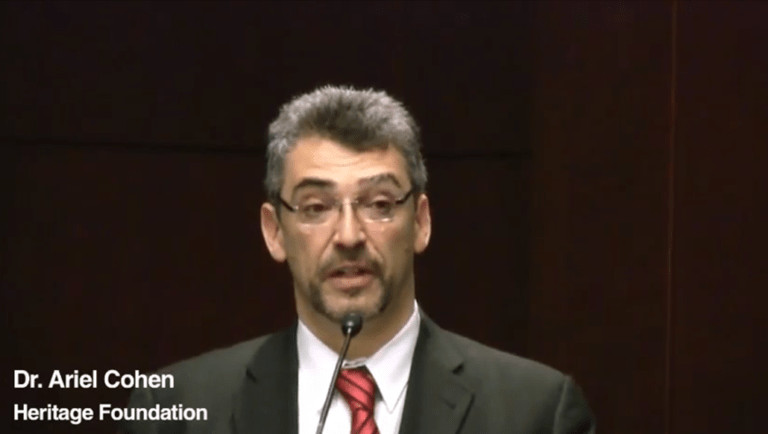
Ariel Cohen: Russia’s Nervous Neighbors: The Outlook After Ukraine
Dr. Ariel Cohen, Senior Research Fellow in Russian and Eurasian Studies and International Energy Policy, The Heritage Foundation speaks at the Center for Security Policy’s National Security Group Lunch on Capitol Hill regarding Russia and the outlook after Ukraine.
Obama’s foreign-policy ‘flexibility’ seen as weakness
The administration Kabuki dance we’re witnessing featuring U.S. refusal to provide nonlethal support equipment for Ukraine is President Obama displaying the new “flexibility” he promised Vladimir Putin he would have after his re-election. In short, it is capitulation.
The administration is trying to make the case that by showing restraint, Mr. Obama will encourage Mr. Putin, the Russian president, to be more willing to negotiate. The mind boggles. What’s taking place in Ukraine has far-reaching implications for the United States and our allies in both Europe and the Far East.
The apparent lack of support from NATO’s political leadership to help Ukraine maintain its sovereignty is clearly tied to its dependence on Russia for more than 30 percent of their energy requirements. This compromised position was accepted based on the assumption that European security after the Cold War could be guaranteed (with reduced defense budgets) by engaging Russia, not confronting it.
This now appears to be a costly error, since it has been known for some time that NATO’s engagement policies have not required Russia’s reciprocity. However, one positive outcome of the current crisis should be an unmistakable wake-up call for NATO, as its credibility is clearly being challenged.
The administration’s rationale for not providing nonlethal equipment, such as night-vision devices, body armor, medical kits, uniforms, boots and military socks to the “victim” is that it could be perceived by Russia as “destabilizing” and as a “force-multiplier,” and, therefore, too provocative. This is nonsense. Russia has deployed 40,000 fully equipped, modernized troops backed up by tanks, aircraft and helicopters, plus paid KGB goon squads that are creating havoc in Eastern Ukraine.
Mr. Obama responds by debating whether to provide what amounts to humanitarian aid because he doesn’t want to encourage Ukraine’s leadership to take more aggressive action to protect its sovereignty. With this type of convoluted thinking, we’d better hope that this administration and its national security team never gets us into a war that requires real leadership.
What is behind such thinking? Is Mr. Obama concerned that Mr. Putin will somehow scuttle his precious P5+1 (the five permanent members of the United Nations — the U.S., Russia, China, Great Britain and France — plus Germany) negotiations with Iran over its nuclear-weapons program? We can only hope that Mr. Putin would take such an action, as those negotiations are nothing but a sham. According to Director of National Intelligence James R. Clapper, Iran could produce a nuclear weapon in about two weeks, once the order is given.
Symptomatic of the Ukraine crisis, no matter where you look, the United States is seen as being in retreat. The stability that America brought to the global strategic equation is being systematically dismantled by the Obama administration, principally by the unilateral disarmament of our military forces.
The Ukraine situation is far from being resolved. China is flexing its military muscle in the Far East. The Middle East remains in chaos. Iran’s nuclear-weapons capability is almost a certainty. With the unpredictability of North Korea, why would the Obama administration at this time make the shocking announcement of deep cuts to the U.S. nuclear forces, four years ahead of the 2010 New START treaty schedule?
Our most secure deterrent, our strategic ballistic-missile submarines, will be reduced by 28 percent by having the capability of 56 launch strikes disabled. Thirty B-52 strategic bombers will be converted to conventional use, which represents a 38 percent reduction in capability, and 50 missiles will be removed from our underground silos, which is the most vulnerable leg of the triad.
With every nuclear power in the world modernizing its strategic forces, particularly Russia and China, plus the known fact that Russia has been cheating on existing treaties, making such a dramatic force-reduction announcement now is more than troubling.
The Obama administration is taking the United States down a course that will put us in an absolute nuclear inferiority position with regard to Russia and perhaps China. It is jeopardizing our national security.
With the United States’ strategic policy adrift, Mr. Putin is controlling events in the Ukraine. With basically no opposition, he will certainly seek more opportunities. In the Far East, we can anticipate that China, seeing our basic inability to respond to the Ukraine crisis, will seize the opportunity to absorb some low-hanging fruit in the South China Sea, most likely contested Philippine islands.
What will it take to make Congress exercise its constitutional responsibilities and maintain its legitimacy by acting in the best interest of the United States? We are being challenged, and we cannot afford to continue to embrace a fantasy foreign policy.
President Obama’s Power is Growing Unchecked, and Democrats in Congress Are Rejoicing

Secure Freedom Radio is made possible by listeners like you.
With Ted Cruz, Claudia Rosett, Steve Bucci, Cliff Kincaid
- Importance of Republicans and Democrats coming together in the House and Senate to unanimously approve a bill banning terrorists from entering the United States as diplomats
- President Obama’s signing statement declaring the anti-terrorist bill to be “advisory legislation”
- Obama’s history of ignoring laws as it suits him—immigration, welfare, Obamacare, etc. laws
CLAUDIA ROSETT, journalist in residence at the Foundation for Defense of Democracies:
- Banning terrorists from gaining and holding UN ambassadorial positions
- The likelihood of Ukrainian dissolution and complete integration into Russia
- North Korea’s progression as a credible nuclear threat to the US and its allies in the region
STEVEN BUCCI, of the Heritage Foundation:
- The possible impact of President Obama’s upcoming trip to Asia on US allies there
- America’s lost ability to properly pivot among world regional problems, a result of the hollowing out of the military
- The Obama Administration’s treatment of Israel, America’s most important ally in the Middle East
CLIFF KINCAID, President of America’s Survival Inc. and Director at the Accuracy in Media Center for Investigative Journalism:
- Unprecedented decision to award the Pulitzer Prize for espionage-focused journalism stories
- German Chancellor Angela Merkel’s controversial past
- Al-Jazeera’s penetration of American media and its association with domestically based Muslim Brotherhood front organizations
Podcast: Play in new window | Download
Subscribe: RSS
Abandoning Ukraine
The conflict between Russia and Ukraine is lurching towards disaster. As predicted, provocations being engineered by Russian operatives and their sympathizers in eastern Ukraine have resulted in clashes with Ukrainian authorities.
Such clashes, in turn, will provide pretexts for those favoring a Crimea-style dismantling of Ukraine to invite Russian assistance. Given that Vladimir Putin has put large numbers of troops on the Ukrainian border ready to cross it at a moment’s notice, an invasion could occur at any time.
Meanwhile, we learn that the Obama administration has repeatedly declined recommendations of the U.S. commander in Europe to provide Ukraine with appreciable assistance, or even intelligence about what Russia is preparing to do. Instead, Team Obama has shamefully confined our support to providing meals-ready-to-eat to a country ready to be eaten.
Russian bear eats Obama’s lunch on Ukraine
The events leading up to the Ukraine crisis and the questionable annexation of the Crimean Peninsula are muddled in half-truths on both sides.
The endemic corruption in Ukraine, coupled with its fragile economy, will hardly make it a poster child for free enterprise and democracy. However, it was a welcome signal that the majority of Ukrainians have opted for a close association with the European Union rather than Russian President Vladimir Putin’s Customs Union. Clearly, this derailed Mr. Putin’s objective of having a pro-Russian government in Kiev.
While Mr. Putin says he will not invade eastern Ukraine, chaos is being created by Russian goons setting the stage for another pretext for forced action. Certainly, 100,000 Russian troops — 40,000 of them deployed along Ukraine’s eastern border — is more than intimidating. Further, it should not be overlooked that all of Russia’s lines of communication to Crimea run through eastern Ukraine.
Mr. Putin has been able to capitalize on events in Ukraine to advance his agenda with little fear of any military opposition. President Obama has made it clear that responding with military force is “beneath” the way he thinks the handling of territorial disputes in the 21st century should be resolved. I am sure this elitist view was well received in China, North Korea, Iran and Cuba, as well as among many of our other potential enemies.
Working through the rhetoric, there is a larger issue that must be addressed; namely, the relevancy of NATO. Since its inception, NATO has been a defensive alliance. While Ukraine is not a member of NATO, other former Warsaw Pact countries, including Poland and the Baltic states, are, and have to be concerned with the uncontested annexation of Crimea.
Further, the abrogation of the 1994 Budapest Agreement raises more questions. In the pact, not only Russia, but the United States and the United Kingdom — both NATO members — guaranteed Ukraine’s sovereignty if it gave up its nuclear weapons.
How did the United States and the United Kingdom plan to meet their obligation under this agreement? It is a matter of credibility. So far, we have turned down Ukraine’s request for military equipment so it could legitimately protect its sovereignty.
In Mr. Obama’s way of thinking, if arms were transferred to the “victim,” Mr. Putin might view such action as provocative. Therefore, the leader of NATO and the free world, transferred field rations, called MREs. How comforting for our friends as well as our potential enemies.
Even though Russia has become a key energy supplier for Germany and the West European grid, its economy is extremely vulnerable to the external demand for its in-ground resources. Compounding that problem is the inherent weakness of its economy, plus its declining Slavic population and a rapidly rising Muslim populace.
Many European Union countries rely on Russia for approximately 30 percent of their energy requirements. Nonetheless, if NATO is to remain relevant, it needs to reassert its fundamental principles and take action that will send an unmistakable message that it will defend itself as well as its newest members.
Such action does not require deploying NATO forces to Ukraine. However, requests for military equipment should be granted so Ukraine can be seen as having a capability to defend its sovereignty.
Key to demonstrating NATO’s determination and solidarity is the execution of visible confidence-building measures. This should include key defensive as well as offensive elements to dissuade Mr. Putin from any follow-on military aggression.
NATO should deploy the latest offensive weapons — F-22s, AWACS, Global Hawks, F-15E, B-2s and Eurofighter Typhoons — and defensive systems such as Patriot and PAC-3 batteries, to carefully selected NATO areas. At least one carrier battle group should be maintained in the Eastern Mediterranean.
Once forces are in place, they need to be exercised in a way that clearly shows NATO solidarity. These exercises also need to include a theaterwide command-and-control exercise. NATO ground forces should also be incorporated as part of the overall exercise program.
The key to demonstrating NATO’s determination and solidarity will not be found in the Saul Alinsky playbook, nor will it be accomplished by “leading from behind.” It will require Mr. Obama to measure up to meet Mr. Putin’s challenge by displaying the necessary leadership NATO deserves. The consequences for failure in meeting this challenge will loom large in the future.